Feeds:
Posts
Comments

Posts Tagged ‘lutfur rahman’

SEE UPDATE BELOW FOR EXTRA LETTER FROM PwC to DCLG

You’ll probably have heard by now (as I predicted here eight days ago) that Tower Hamlets council is filing for a High Court judicial review of Eric Pickles’ decision to send in PwC to inspect their accounts.

They announced their move yesterday, the day after Eric stood up in the Commons to tell MPs the council had caused a “considerable delay” in the inspection by failing to provide documents.

The full grounds for the council’s court action aren’t (as far as I’m aware) yet publicly available. Lutfur Rahman’s team (advised and encouraged by interim/consultant monitoring officer Meic Sullivan-Gould) believe they have a good case, although they haven’t yet laid it out.

The writ will become publicly available soon enough, but all we have to go on at the moment is a letter written by the Mayor to Eric Pickles yesterday. And that seems to focus on the costs of the audit, which the Government has estimated at about £1million.

That £1million will be borne by Tower Hamlets council, presumably regardless of the outcome.

So you can see there is a game of very high stakes poker here…and it’s not just limited to the politicians. Remember who wrote to the council’s Macavity Cat head of paid service Stephen Halsey in the first place? Answer…Sir Bob Kerslake, who is not only the permanent secretary in the Department for Communities and Local Government, but also the Head of the Civil Service itself.

If LexLutfur/Super Rahman wins, both Eric and Sir Bob will have some pretty serious explaining to do to Parliament. Which is partly why the DCLG said it would “robustly” contest the judicial review yesterday. Another simpler reason might be, of course, that Sir Bob strongly believes the decision was correct.

That said, I thought it would be useful to highlight here in one place all the publicly available correspondence on this issue.

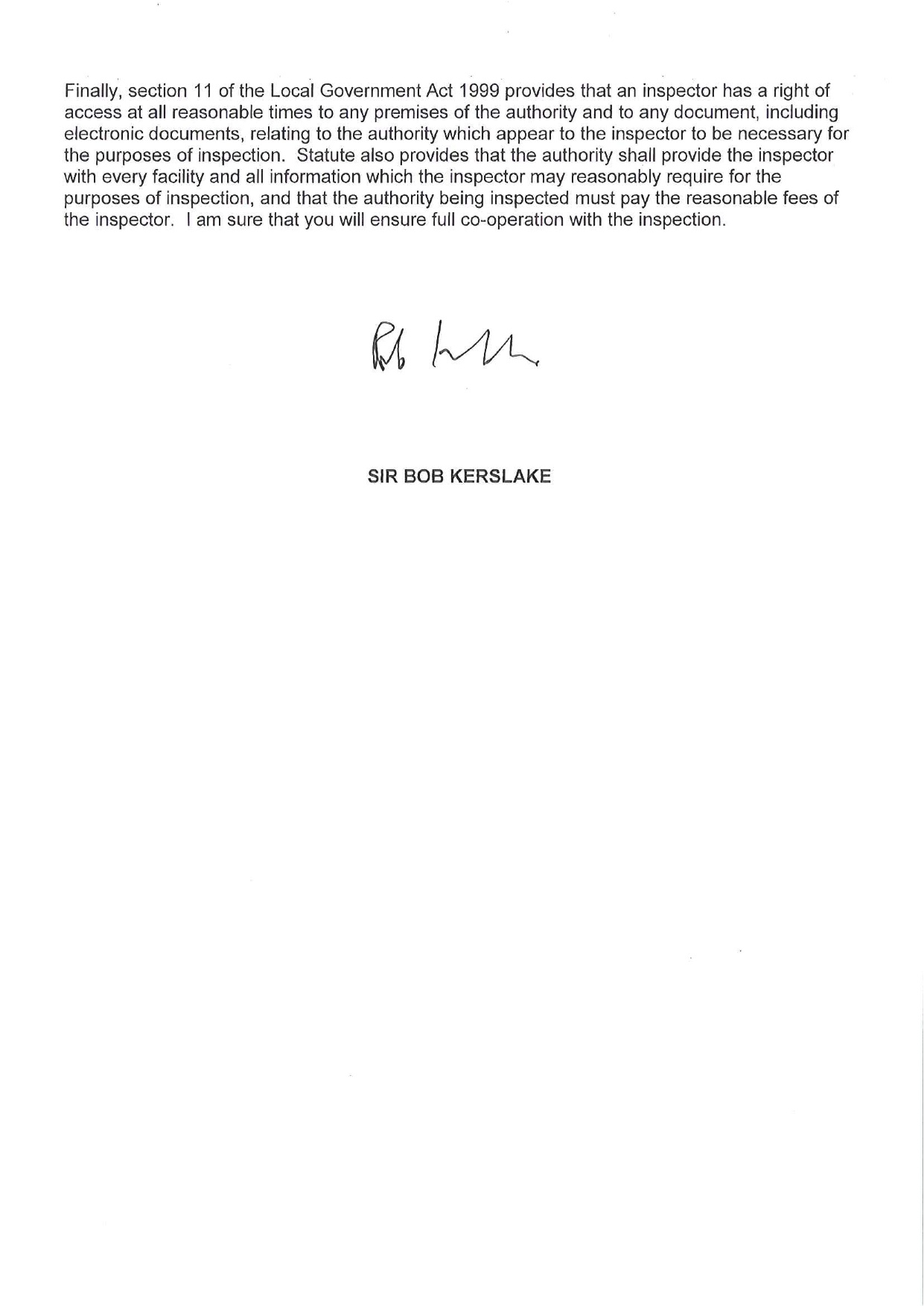
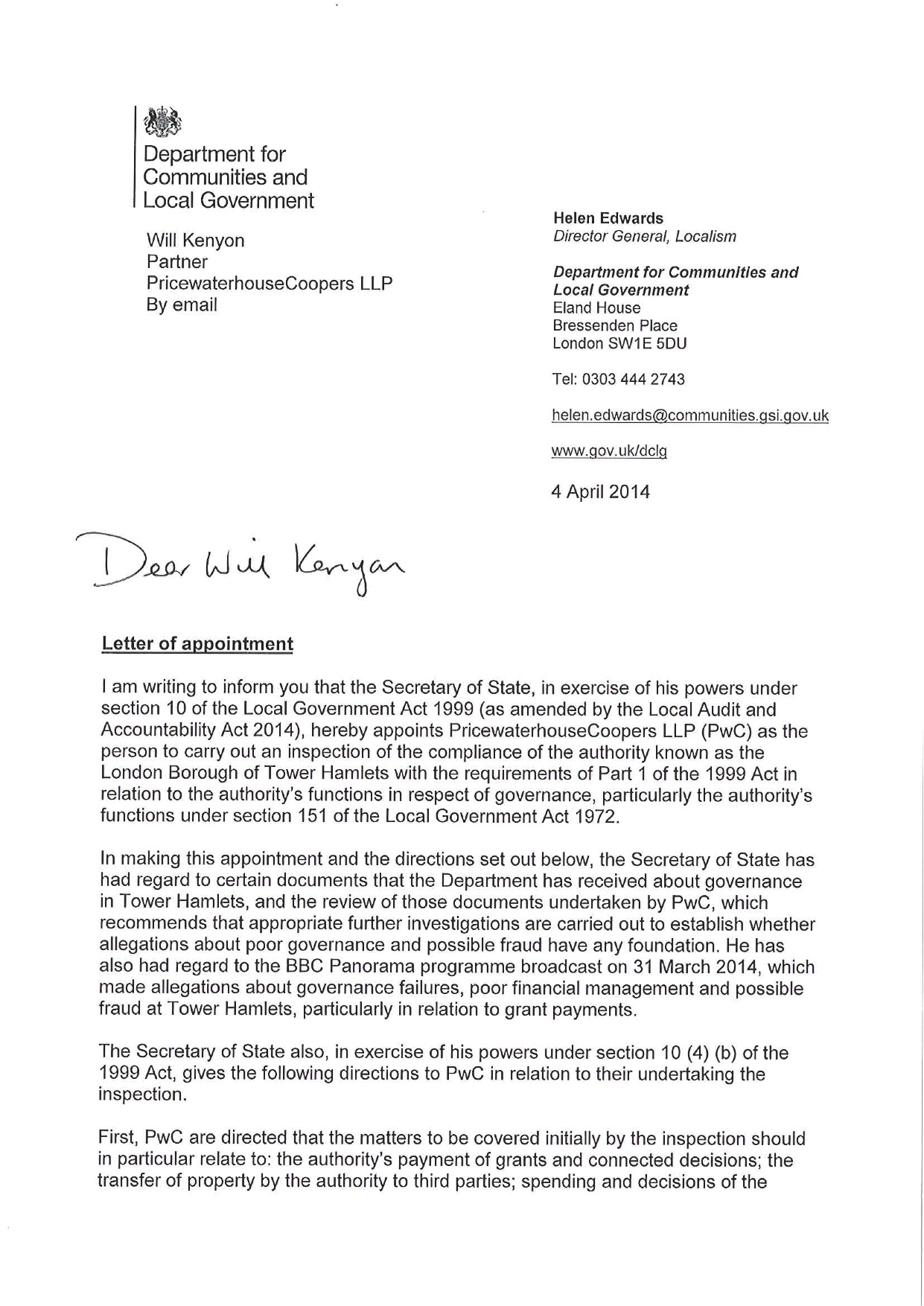
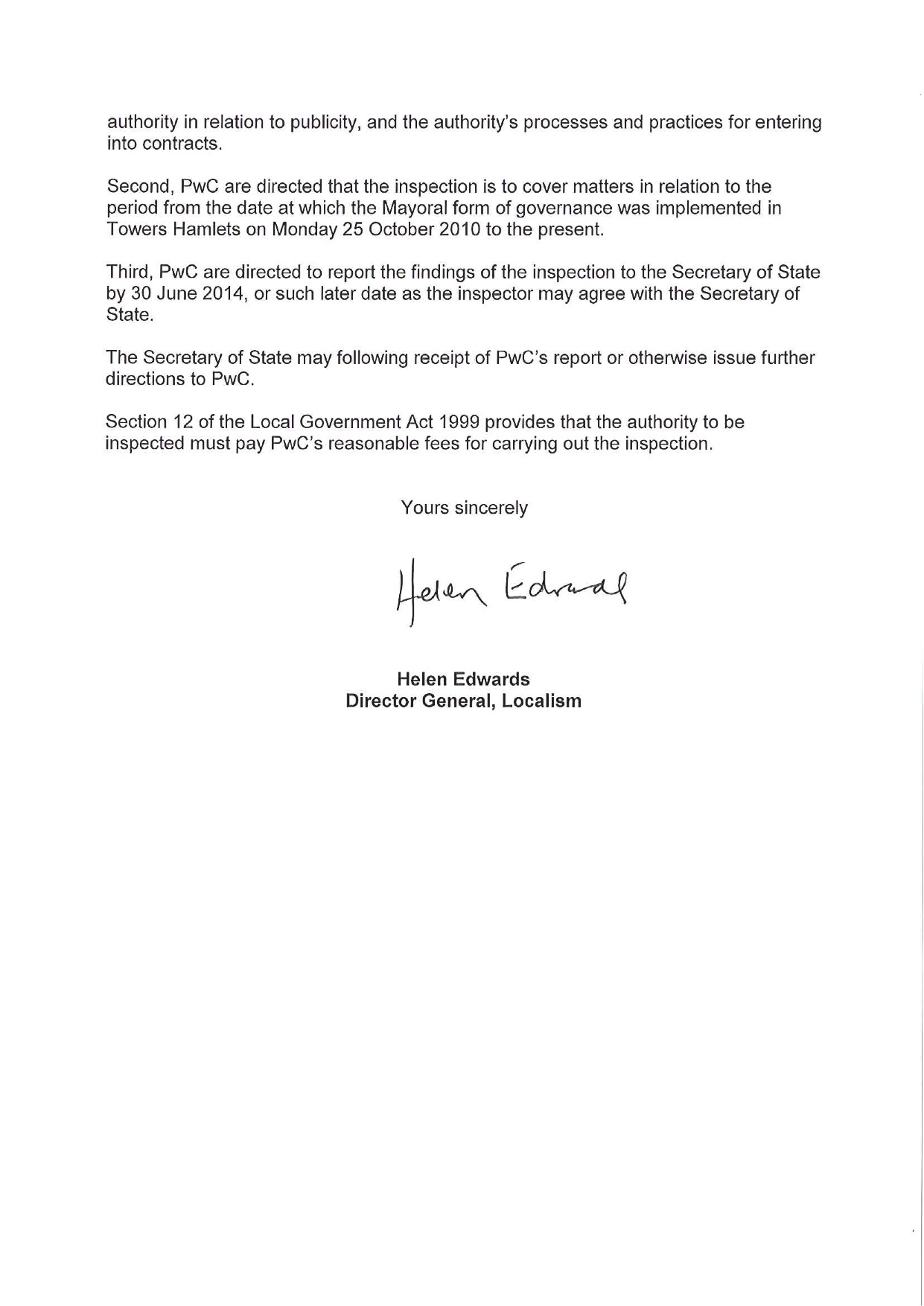
Here are the letters from April 4 from Sir Bob to Halsey and from the DCLG’s Helen Edwards (in charge of the Localism section) to Will Kenyon, the partner at PwC:

bob kerslake, tower hamlets BK to SH 4 April2 PWC - Appoint finalPWC - Appoint final2These letters outline the scope. They say DCLG has received documents suggesting poor governance and suggesting possible fraud. They say PwC has had an initial review and further investigations are recommended. They say a file has been passed to the police and that the Panorama programme on March 31 has also raised further concerns. They say the inspection’s scope will relate to grants, transfers of fixed assets, the council’s publicity, and the way the council enters into contracts.

On the file to the police. We know the Met announced in May that it found “no new credible evidence of fraud”. But those files in DCLG’s possession did contain evidence of possible fraud in relation to the council’s dealings with the Brady Youth Forum. We also know that the council was aware of that alleged fraud in January (following a report by internal auditors Deloitte) but that was only reported to the police TWO months later AFTER Panorama started asking the council questions about it. It’s a good bet that PwC are asking why.

On the Panorama programme. I’m not sure Sir Bob is right to say that Panorama in its broadcast alleged “possible fraud”. It didn’t mention fraud at all. It questioned Lutfur’s governance.

On the scope of the audit, the areas look fairly clear to me, although I can see why the council might be arguing vagueness in relation to the way into enters into contracts. That said, without the keys to those doors, PwC would be pretty hampered.

On costs. Sir Bob tells the council it must pay PwC’s “reasonable fees”. Reasonable is a term loved by judges and lawyers and it means what it is. PwC isn’t allowed to lengthen the investigation merely to inflate its fees. And would it be reasonable to (as the council suggests) place a cap on PwC’s costs? PwC will go where the evidence takes them so this might well explain the frustration felt by council officers at having to produce yet more files as well as overseeing the “excellent” everyday services the council carries out.

Which brings us to the next set of letters.

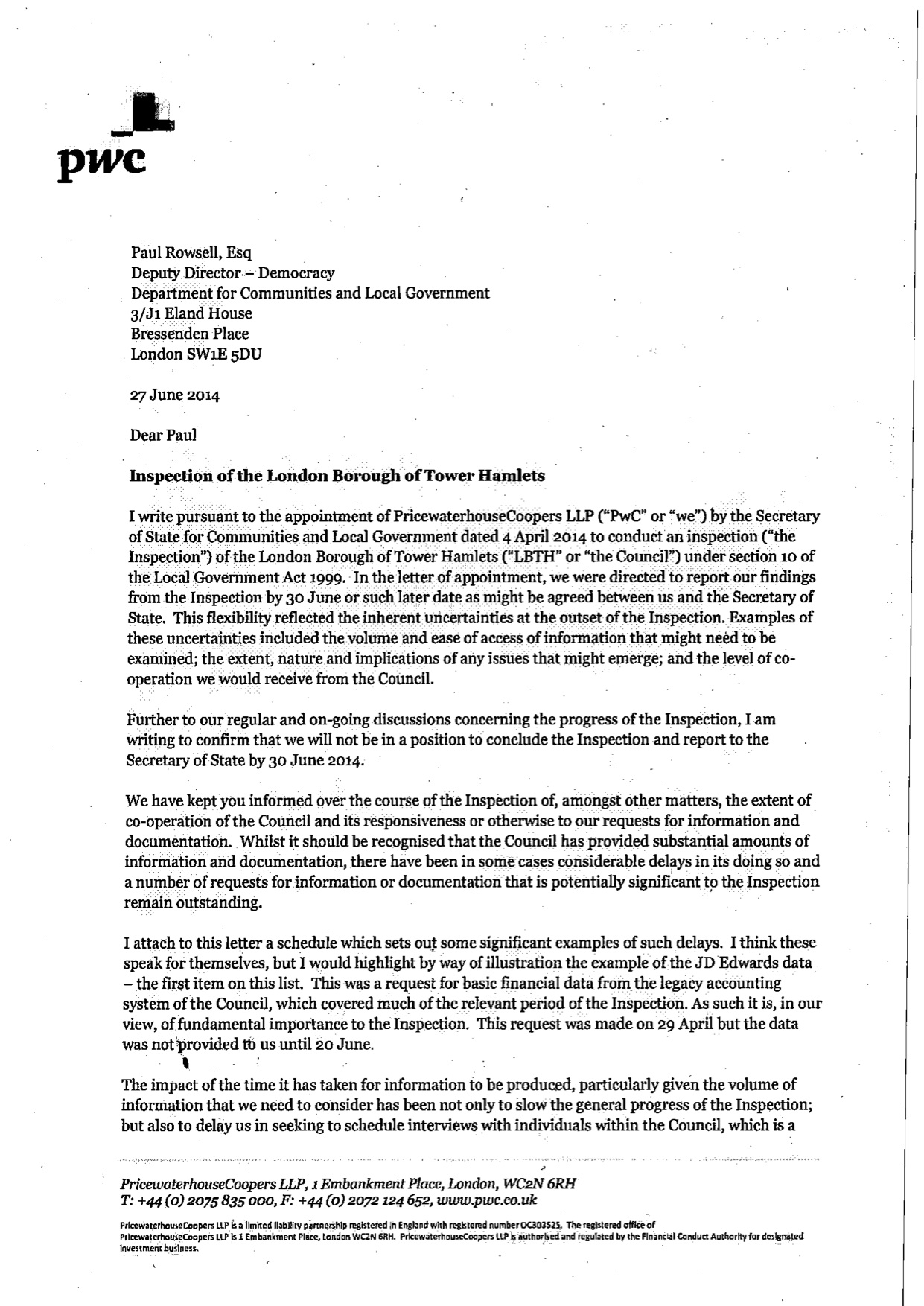
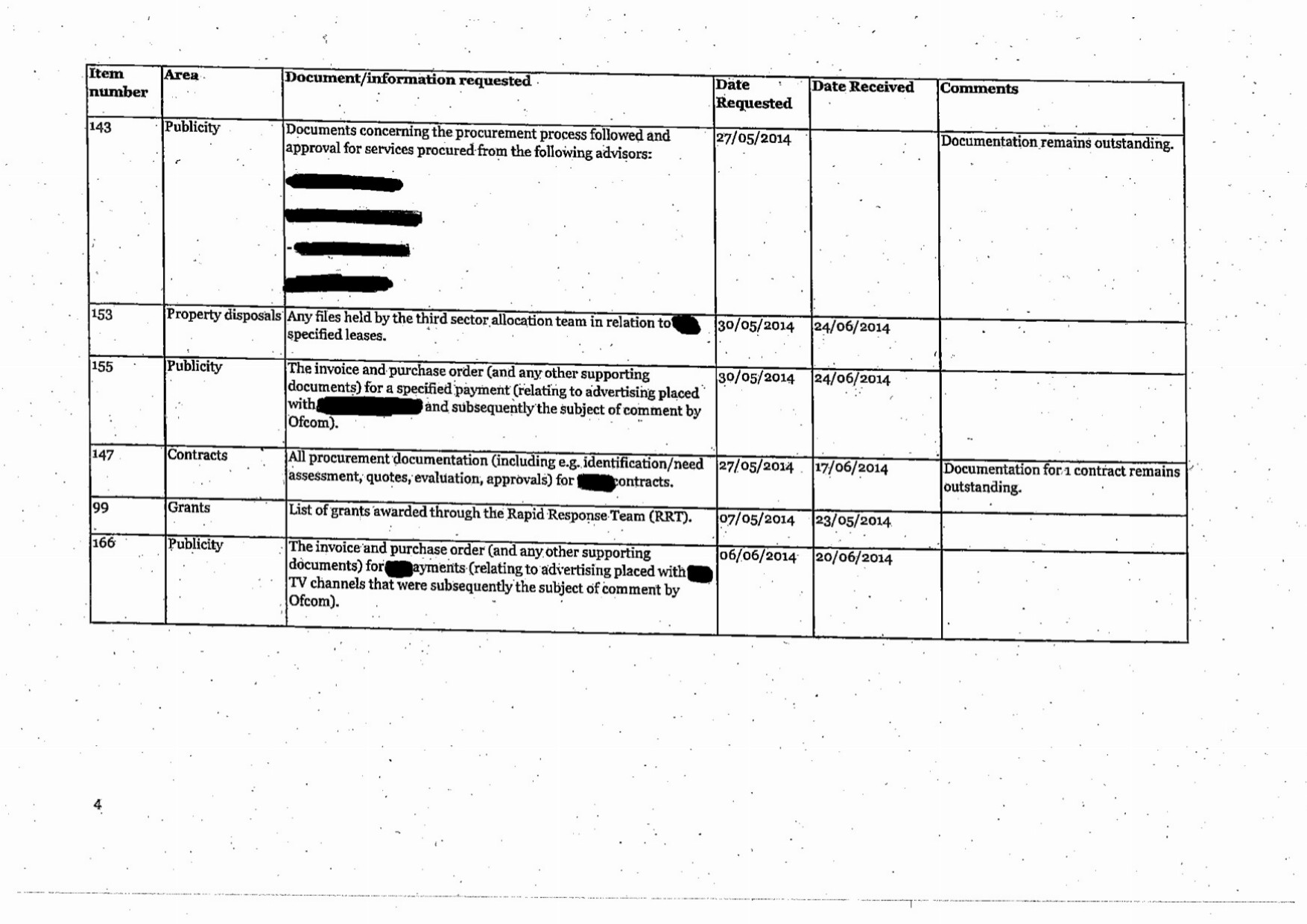
*UPDATE: Thanks to Mark Baynes of the Love Wapping blog for highlighting this next letter, which I missed from the original post here. It’s a letter from Will Kenyon at PwC to Paul Rowsell, a senior director at the DCLG. In it, Mr Kenyon outlines the delays and gives examples of missing information. It’s a very useful insight into the kinds of questions being asked and paperwork sought. It’s a mind-numbing task and helps explain why auditors are paid so well… . One of the questions appears to relate to an advert placed with five Bengali TV stations, including Channel S, which was later censured by broadcasting regulator Ofcom.


140630_-_PwC_to_PR_final

140630_-_PwC_to_PR_final2

140630_-_PwC_to_PR_final3

140630_-_PwC_to_PR_final4

[No doubt, the auditors will also have come across this other example of procurement in Takki Sulaiman’s communications department, ie when in 2012 a botched deal to put up banners of the Mayor was given to Fortuna Associates, a consultancy run by Chris Payne who had a few months earlier been a mate of Takki’s as the head of advertising for East End Life.] /END UPDATE.

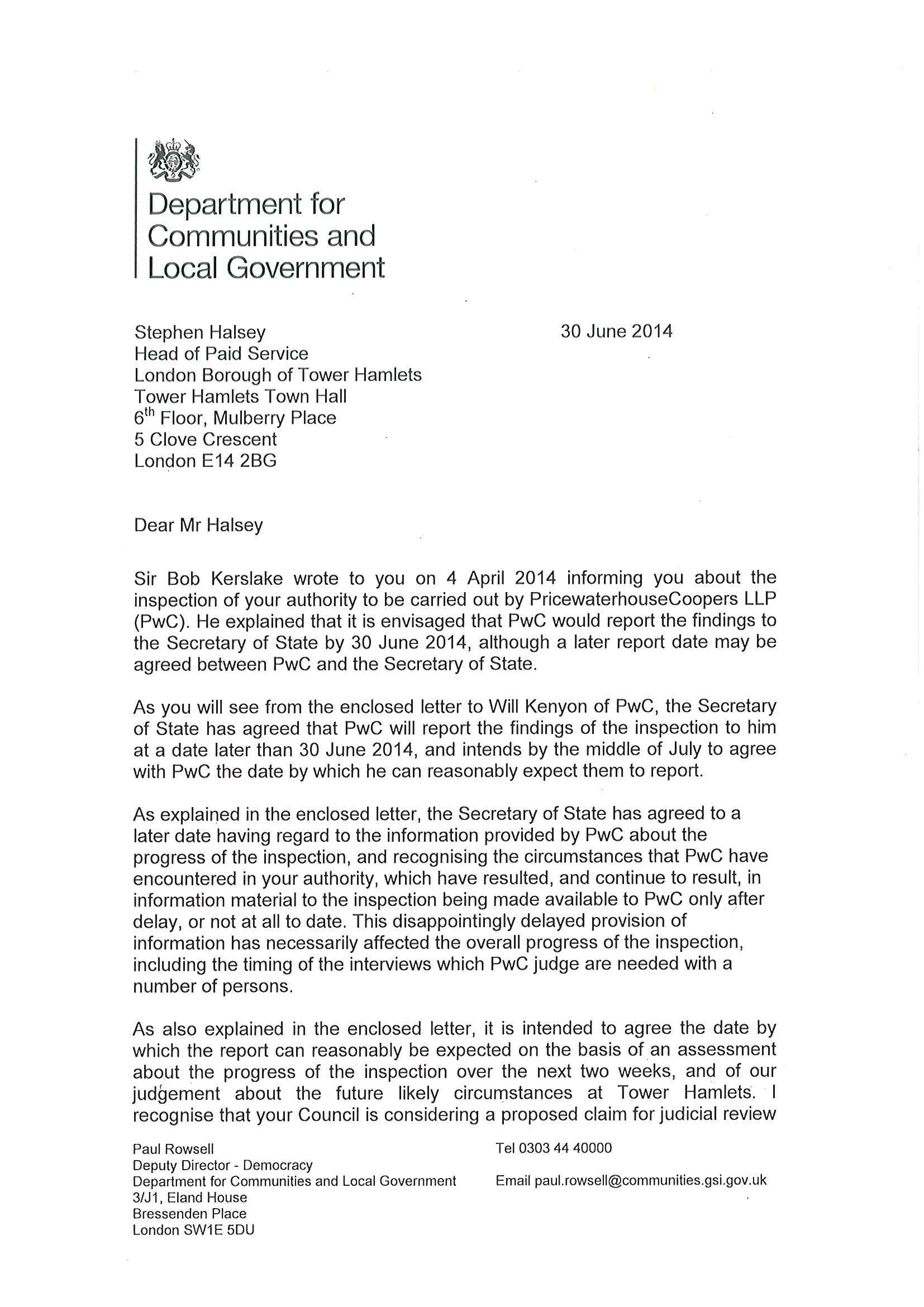
Here’s the letter from Paul Rowsell at DCLG to Stephen Halsey on Monday, June 30.

140630_-_Paul_Rowsell_to_SH_-_final_Page_1

140630_-_Paul_Rowsell_to_SH_-_final_Page_2

This expresses disappointment at the delays caused by the council. It also uses some alarmingly strong language about “material” affects on the “future circumstances at Tower Hamlets council? Is this a first indication/warning that some central government intervention and control is being planned? (The Mr Holme referred to is Chris Holme, the director of finance at the council.)

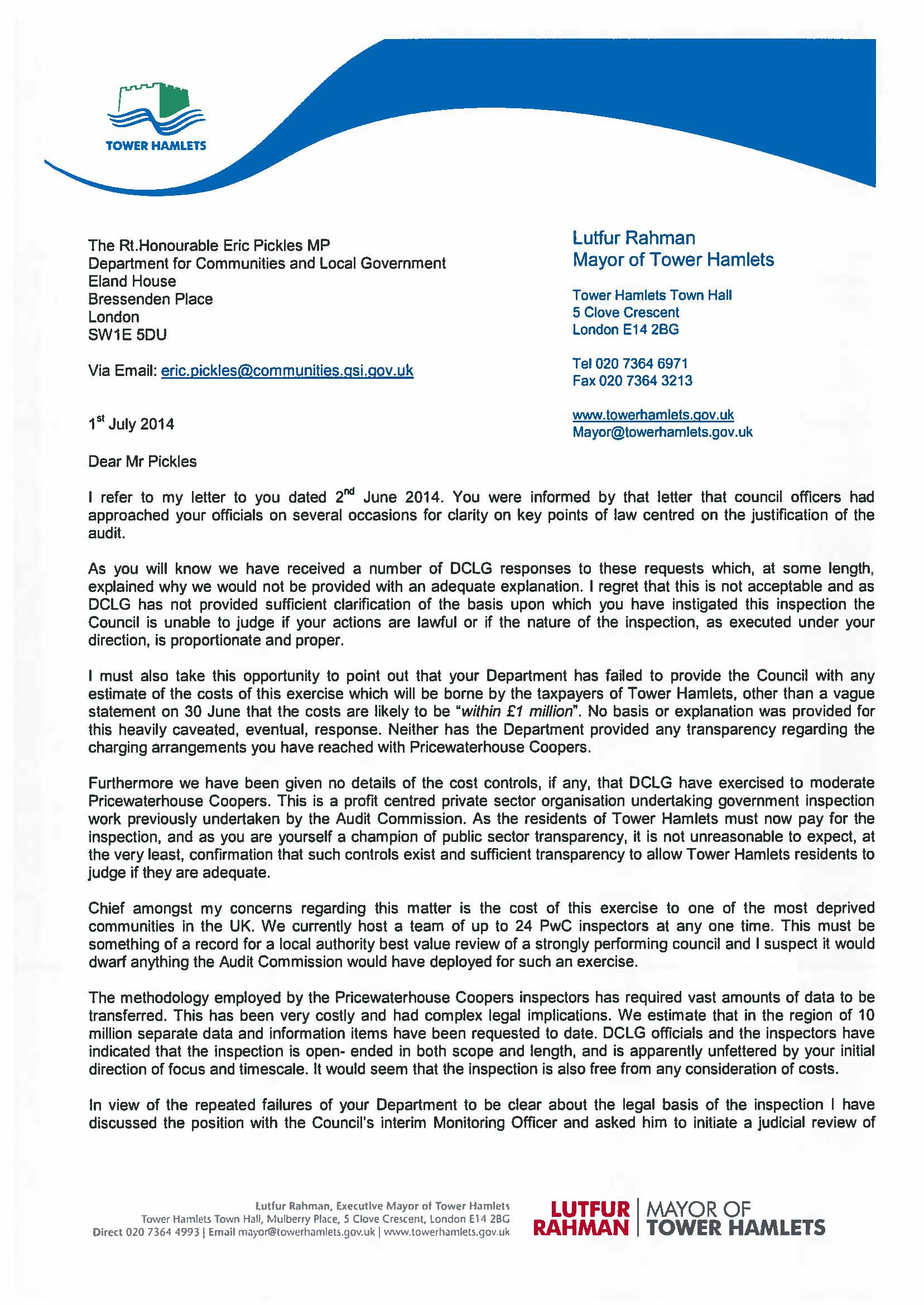
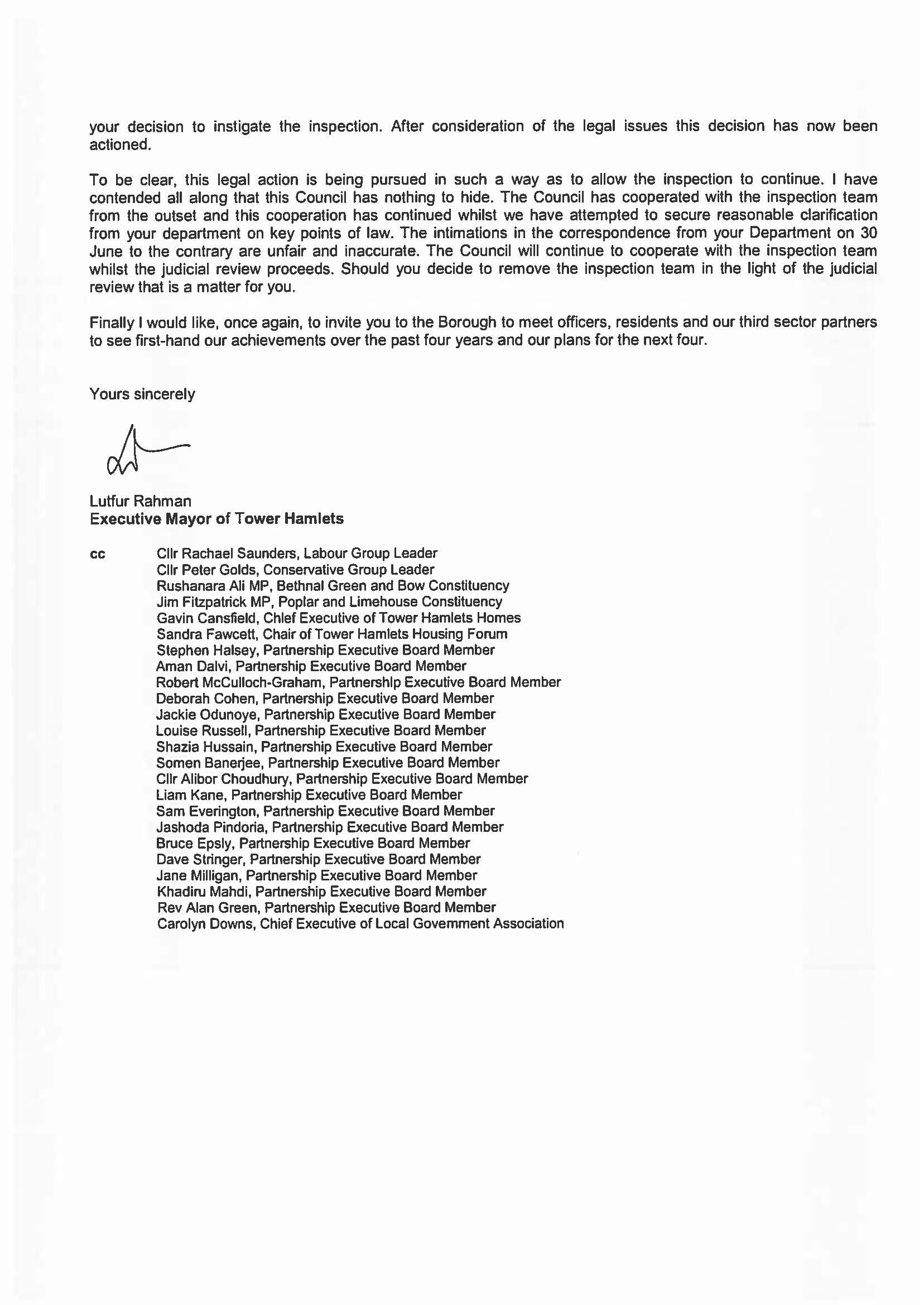
And this is Lutfur’s letter to Eric Pickles in response yesterday:

Letter to Rt Hon Eric Pickles - 1 July 2014_Page_1

Letter to Rt Hon Eric Pickles - 1 July 2014_Page_2

Just as Eric Pickles may have tried to make some political capital out of the delay to the audit in the Commons on Monday (by triggering suggestions the council was withholding documents, when the reality could well be they just can’t find them quickly enough, or they don’t exist), Lutfur, too, goes down that route.

From his letter we learn there has been a series of other unpublished letters in which the council has been complaining about justification, scope and costs. The great champion of public scrutiny and transparency that is Tower Hamlets council and its mayor say DCLG hasn’t been transparent and that it has failed to answer questions. I think that may have caused one or two ironic giggles at DCLG.

However, on the substance…Lutfur is entitled to ask about costs and cost controls. It would seem unfair if Tower Hamlets council taxpayers were to pick up the tab for any failed governance by its politicians and officers, or none at all. If the PwC report gives a clean bill of health, then surely there must be a clawback from Whitehall. If the report is damning, Pickles would be wise to say DCLG is picking up the tab as he installs emergency measures at the council. Either way, the residents in “one of the most deprived communities” in the UK (as Lutfur says) should not be penalised.

I’m also puzzled why Lutfur has been persuaded to insert into his letter absurd references to “10 million” items of data requested by the PwC. It sounds like a cheap line concocted by interim officers and communication chiefs. Maybe someone should FoI how they calculated 10 million and how long that exercise took them. As Cllr Andrew Wood, an accountant, pointed out here yesterday:

As a qualified acceptant who has been audited many times by PWC, I agree the 10 million separate data items is complete rubbish. There might be one request to provide all invoices paid by the council over the last year which might generate one spreadsheet with millions of cells but downloading it from any normal system only takes maybe a few hours or maybe an overnight batch run.

Takki and co may think this is a headline grabbing line for some press outlets, but it makes the council and the mayor look stupid.

As for what happens next…the council’s writ will be lodged and heard before a judge imminently.

And in the meantime, DCLG will continue its contingency planning. One thought: Tower Hamlets council is still without a chief executive; if the PwC report does come back with major failings, it would seem a perfect opportunity for him to install one. The last time he did that was in 2011 when he approved no-nonsense Jo Miller to run failing Doncaster Council.

Granted, there were much bigger service failures at Doncaster but there were similar dysfunctional politics to Tower Hamlets. Jo is highly regarded in Whitehall and many think she has turned the council around. When her job is done there, might Tower Hamlets be her next challenge?


Read Full Post »

For a council perpetually under the cosh, Tower Hamlets doesn’t exactly help itself in the matter of public perception.

While I and many other journalists are used to being delayed by the Communications and Freedom of Information departments (actually, it sometimes seems they are one and the same), it’s probably not a good idea to deploy similar tactics with Government appointed inspectors.

Last week, I revealed that PwC had asked Eric Pickles’ Department for Communities and Local Government for another month to file their emergency report on transparency and governance.

Some on this blog speculated it was because the auditors had pre-booked holidays to honour. But it doesn’t work like that.

Today, Mr Pickles explained the delay to the House of Commons:

The investigators PwC have informed me the council has considerably delayed the investigation by delaying the provision of key information or simply not providing it at all. This is simply not acceptable and I am consequently extending the period for PwC to report. The cost will be met by the council. Whether the council likes it or not, this investigation will be thorough and comprehensive and I will update the House in due course.

Yes, there’s an element of politics in the language, but given it is PwC itself telling the Secretary of State the delays have been caused by the council, it’s serious stuff.

I have no idea what information the council is failing to provide. It could be a deliberate delaying tactic by the town hall’s lawyers (loose-tongued interim monitoring officer Meic Sullivan-Gould is in charge, so fear not taxpayers!); there’s some speculation they are considering an expensive Judicial Review on the audit.

That could also be the reason why the council is also refusing to supply me and other journalists a key spreadsheet. The day after the Panorama programme, Takki Sulaiman, the Head of Timely Communications, issued a statement to say the BBC had got its sums wrong. He said only £1.6m of the latest grants round had been awarded to organisations which had a Somali or Bengali CEO, chair or applicant. Panorama had accused Mayor Lutfur Rahman of increasing funding to Bengali and Somali groups by £2.1million to £3.6million.

We asked the council for a detailed breakdown of its numbers.

Last week, they refused the FoI request by relying on a Section 22 exemption, namely that the “information is being re-evealuated and it is intended to publish the information through the appropriate channels”. When I called for an explanation, an officer told me they were waiting for the PwC audit to finish because this information was being examined by them.

So I asked Will Kenyon, the PwC partner in charge of the audit, whether he had been consulted about the FoI request/refusal and whether he had asked for the answer to be delayed.

He replied:

As far as I am aware, your FOI request to the council has not been raised with us at any stage, nor has there been any discussion concerning the publication of the information you refer to.

So while the council was exceptionally quick to fire off its “rebuttal” statement in the wake of Panorama, it has been characteristically slow in providing the proof.

And still they complain when people ask “What have they got to hide?”

Read Full Post »

England may be out of the World Cup but the summer agony is set to continue for Tower Hamlets council and its residents.

I understand that PricewaterhouseCoopers, the auditors ordered in by Eric Pickles in the wake of the Panorama programme on March 31, have asked for another month to write their report.

They were due to file it with the Department for Communities and Local Government by June 30, but that has now been delayed until the end of July.

That might well be because they have so much more work than at first realised, or because they just need more time to reflect and analyse their findings: they’ve been inundated with information, that’s for sure.

Mayor Lutfur Rahman told BBC London radio’s Eddie Nestor last week:

I don’t believe they will find any serious irregularity in any of our governance, our financial structures or the way we run the council.

If there is any issue here, of course we will look at it and try to learn from it and try to improve on it, but don’t forget, if he was looking for fraud, he will find no fraud.

This seems an implicit acceptance the auditors will find something. Team Lutfur say that’s inevitable: put in a team of highly skilled auditors into any borough for a concentrated period of time and murky details will surface, they say. It’s just a question of seriousness.

I wonder how the council will react. I wonder whether they might even resort to their favourite tactic of hiring expensive barristers and contemplate a judicial review of the decision in the High Court.

Personally, I don’t think the auditors will find any outright fraud (on the whole, they have a good team of senior officers in Tower Hamlets) and certainly the Panorama team never made that allegation. There’s an element of ‘creating goalposts’ within the Lutfur spin camp on this.

I also think there’s an acceptance within his team that they got things wrong in the past four years on the questions of transparency and governance. Lutfur says in his fascinating interview with Eddie Nestor that he has no idea why Tower Hamlets attracts so much bad press. Well, he didn’t really help himself on the questions of perception and appearance, did he? The chauffeured Merc, the prominent associations with rogues and criminals like Shiraj Haque (I’ll be kind and say ‘the former’) and Mohammed Mahee Ferdhaus Jalil (twice the latter), the failure to answer questions in council, the failure to attend hustings etc etc.

He has a much bigger group of councillors to manage this time as well and hopefully they will ensure these matters are addressed. He’ll probably enjoy the challenge.

Here’s the interview with Eddie Nestor: it’s 20 minutes but certainly worth a listen.

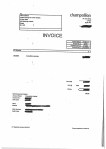
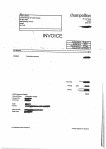
As for the council’s commitment to transparency, I leave you with this FOI response they gave me yesterday. I’d asked for all invoices supplied by the Champollion, the expert PR outfit they hired to counter the Panorama programme.

Here are the invoices they supplied:

Here’s the explanation:

In terms of the Champollion contract the Council officers took the view in late January 2014 that in order to ensure the position of the council was clearly represented to the production company and the commissioning organisation, specialist media advice was required.

The in-house media team did not have specialist knowledge about the operation and application of the BBC’s editorial guidelines and were already occupied in managing an existing workload.

A brief was produced and a Record of Corporate Directed Action (RCDA) was signed by all relevant officers to consider the procurement issues involved. Given the short timeframe and the specialist nature of the advice required a longlist of specialist PR firms was identified. Four companies were then invited to apply after receiving a brief and invited to interview.

Section 36 (2)(b)(i) has been applied to the financial elements of both contract and internal discussion between officers on the basis that their disclosure would inhibit the imparting or commissioning of advice subject to the public interest test and information relating to financial and business affairs which could prejudice the Council achieving its obligation to obtain best consideration from the use of its resources and the best value from the procurement process. 

Section 36(2)(c) has been applied to elements of the Champollion contract as the brief point 4 (a specific requirement concerns seeking strategic or tactical advice from the contractor) and point 8 (dealings with the BBC) and this forms part of the internal thinking space of the Council which if it were to be released would prejudice the effective conduct of public affairs. The Council needs to be able to examine the options. 

Bollocks.


Read Full Post »

The investigations are piling up in Tower Hamlets. Today, The Times reported on its front page that:

Britain’s first directly elected Muslim mayor has been accused in the High Court of involvement in electoral fraud and illegally smearing an opponent.

Groups of people were paid to gather outside polling stations and persuade voters to back Lutfur Rahman on election day last month in Tower Hamlets, east London, an election petition claims.

The mayor’s supporters are accused of canvassing inside polling stations and accompanying voters to booths where they left election material urging people to vote for him, according to the petition.

Mr Rahman, who was born in Bangladesh, or his team cast postal and other votes in the names of people who were not entitled to be on the electoral roll, and acquired voting papers that they completed in favour of the mayor, the documents claim. If proven, the actions would be against electoral law.

The court documents allege that corrupt or illegal practices were so prevalent that they affected the result of the election. Mr Rahman, an independent social democrat, was the first directly elected mayor of Tower Hamlets in 2010, winning 52 per cent of the vote. Last month he won re-election in a closer contest, where he received 43 per cent of first-preference votes but beat Labour by 37,000 to 34,000 when second preferences were included.

If the petition is successful, the mayor faces a rerun of the poll. He could be banned from holding office if the High Court finds evidence of electoral mispractice by him. His agent condemned the petition as a waste of time and money. Gerald Shamash, the Labour party’s national solicitor, has been hired by the petitioners, a cross-party selection of local voters.

The petition claims that the Labour mayoral candidate, John Biggs, was wrongly smeared as a racist during the campaign. Deliberately making false statements about an opponent’s character is against election law. Mr Biggs, who is white, was accused of racism for saying that Mr Rahman’s primary focus was the Bangladeshi community.

The Labour candidate, a senior member of the London Assembly and former leader of Tower Hamlets council, said last night: “I was distressed by the accusations, which have no foundation. They were part of a cynical campaign to try to polarise community opinion.”

John Williams, the returning officer for the mayoral election, is also named on the petition in relation to separate allegations. The complainants blame him or his officials for allegedly letting Mr Rahman’s supporters enter polling stations, where they are accused of canvassing voters, accompanying them into polling booths and leaving campaign material around the booths.

It is alleged that the count was impeded by the large number of Mr Rahman’s supporters who attended.

Mr Williams said that the toughest measures were put in place at the election. He said that 84 allegations were passed to police. In most cases no evidence was found but eight were still under investigation.

The petitioners are Andy Erlam, an anti-corruption candidate, Debbie Simone, a Labour candidate who lost her seat by 28 votes, Azmel Hussain, a Labour supporter, and Angela Moffat, a Ukip supporter. The High Court is being asked to break the seals of the ballot boxes to check that votes were correctly cast and counted. A source said that Labour was not party to the petition but did not oppose it.

Mr Rahman’s agent, Alibor Choudhury, said: “All candidates in the mayoral election accept the results. The returning officer and the police pursue all allegations and complaints reported to them. This petition challenging the results does not raise any new issues or evidence.”

The court documents can be read in detail here:

On Iain Dale’s LBC radio show tonight, John Biggs said he supported the petition. Peter Golds, the Tory opposition leader, has made a small contribution to the petition’s legal fighting fund.

The petition has now been served on the Mayor, the Director of Public Prosecutions and the Returning Officer; the petitioner’s must now apply to the court to fix a date with an election judge within 28 days.

If a hearing is granted, the first thing that will be asked for, as I understand it, is a recount and new scrutiny over the vote.

Again as I understand it, the allegations of corrupt electoral practices also apply to Lutfur’s agent, Alibor Choudhury. If proved against Lutfur himself, he faces being removed from office. If only against Alibor, then we face a rerun of the election. Alibor and Lutfur strongly deny any corrupt practices.

The other interesting deadline looming is the submission of election expenses by the various parties on June 26. During the campaign, Labour raised collective eyebrows about how well funded Lutfur’s machine was. But I’m sure Lutfur’s submission will suggest his expenditure was within the limits.

This is going to be a busy month for Lutfur and Tower Hamlets. The by election in Blackwall and Cubitt Town is preoccupying the political parties, but there are also various investigations that have the potential to build a head of steam, or running out of puff.

Here are just the ones I can think of:

  • Election petition
  • various criminal investigations into alleged electoral fraud
  • complaints to the police about using ‘fake’ addresses on nomination forms (thoroughly recommend this piece by Andrew Gilligan on Sunday, which refers to Kabir Ahmed, among others)
  • Review by Electoral Commission into the May 22 counting shambles
  • Interim or final report by the PwC auditors ordered in by Eric Pickles last month (deadline June 30)
  • Criminal investigation by the Information Commissioner’s Office into the so-called Panorama “whistleblower”

Arch-villain or superhero? Lex Luther or SuperRahman? Take your pick.

If anyone spots orders for Teflon and Kryptonite in the next set of Tower Hamlets supplier payments, you’ll know why.

250px-Luthor_bright

Read Full Post »

Pleasing TakkiTo cut a long story short, I was ejected from a Tower Hamlets council meeting tonight and frogmarched out of the town hall by two uniformed security guards on the orders of Head of Communications Takki Sulaiman.

Because I told him he was acting like a prick.

I regret my choice of word. Four letters would have been enough.

He and I have a long history. He dislikes my journalism and I dislike his attitude to press freedom.

I’ve covered Tower Hamlets for nine years now and in that time I’ve seen a gradual erosion in the access afforded to reporters wishing to cover council meetings. That erosion didn’t start with Takki’s management of the communications department, but he has contributed to its acceleration.

He frequently converts press queries to Freedom of Information requests on the spurious grounds that they’d otherwise cause his team (which produces East End Life) too much work.

A couple of years ago, I felt he tried to get me the sack at the Sunday Express by writing to my editor because he objected to me using a scanner in my employer’s office.

And in 2011, he ordered the permanent removal of the reporters’ table that had been a fixture at the very front of the public gallery in the council chamber. After that, the council started reserving seats in the front row for reporters.

This last point is relevant to tonight’s events.

The meeting started at 7.30pm. I arrived some 10 minutes earlier. The public gallery was packed. I stood in the doorway of the council chamber looking for a seat and as is often the case, councillors and others came up to me to say hello.

I saw Takki sitting in a seat not far from the front. There was a space next to him, which he said had been reserved for East End Life. I asked another officer to show me the reserved press seats. She told me Takki had given them all up to members of the public. I asked why. She asked Takki. He told her because I hadn’t responded to an email to say I was coming. I told her I don’t think I ever got an email.

Besides, the council had clearly been expecting me. Here’s the ticket that had been waiting for me in the town hall reception when I arrived:

photo

I was then told I’d have to sit at the back of the public gallery behind a large pillar that obscures the entire council chamber. I told the council officers that that was completely unsatisfactory. By this time Takki had given up his seat for a member of the public.

I then stood at the back of the public gallery in the far corner of the room where I could see (from a distance) the backs of three councillors’ heads.

I started tweeting this and remarked that East End Life had been given a reserved seat. Takki strode over with his iPad. He was logged on to my Twitter timeline. Like many others, he probably enjoys my live tweeting of these meetings. Bless him. He said Laraine Clay, the East End Life editor, was using a crutch and that’s why he’d reserved her a seat. Fair enough (and let me stress as I have on many occasions my deep respect for Laraine). I asked him when he’d sent me the email about reserved seating. He said one of his team had sent it. I said I didn’t get one and that anyway it was irrelevant. As he turned his back to walk away, in a quiet voice, one on one, I told him he was acting like a prick. He asked me to repeat it. So I did. He then asked whether I’d like to be removed from the gallery. I said, ‘Do what you want Takki, I’m trying to report.’

He then hurried off and walked into a wall.

Then a few seconds later, two THEOS (Tower Hamlets Enforcement Officers) approached me. They asked me to leave the gallery. I followed them. Takki was waiting in the corridor outside. He asked me whether I’d called him a prick. I said Yes. He said I’d have to leave the building and the two THEOS walked me to the lift, got in, shook their heads in embarrassment and made sure I left the town hall.

The Evening Standard has covered this tonight. It’s another PR disaster for a council that desperately needs to improve in that department. And caused by the man who runs that department. Ours was a verbal spat between two grown adults – a hack and a spin doctor who are used to trading industrial language. And it comes at a time when there have been attempts behind the scenes to draw the poison from the political situation.

He says in a statement tonight: “This is my workplace, I have a right not to be abused in my workplace. I don’t know any other walk of life where it would be justified.”

Well, let’s try Tower Hamlets politics shall we? Over many years, both he and I have witnessed abuse hurled at councillors from the public gallery, some of it homophobic, some of it about personal appearance.

And in none of those instances did Takki or anyone else ask for people to be evicted.

In fact, the only other time I can remember Takki & Co asking someone to be marched out was last year…when the redoubtable John Wright, a 71 year old Alzheimer’s Ambassador was physically removed from the chamber for having the temerity to film proceedings after Eric Pickles had said ‘Go ahead’.

Anyone spot a pattern here?

PS Oli Rahman was named Deputy Mayor tonight. Congratulations to him. I’ve never heard him swear in my life. Ahem.

Read Full Post »

This is a guest post by former Labour councillor Carlo Gibbs, who was defeated in the St Peter’s ward on May 22. He was Labour’s spokesman for finance until then and is married to serving Labour Cllr Amy Whitelock Gibbs


Carlo_webThoughts on defeat

So. First off we have to congratulate Lutfur and his campaign team on their victory last Thursday. Regardless of views on him, you have to accept that he secured a big victory against a strong opponent. It also has to be recognised that the people have decided through elections that were free and fair and conducted under the most intense scrutiny. This was the result and we have to accept that. While there may be complaints about intimidation at polling stations and elsewhere, and any evidence should be looked at and referred to the appropriate authorities, this would not have shifted 3500 votes towards John Biggs or 174 to me in my ward.

As always with defeat, it is a time for reflection and this is something the Labour Party now needs to do before picking itself back up and moving on. We are a national party and will never give in, there is still fight in us yet and we will continue to represent the community and promote our values with our councillors and activists. Those who have said that we’re finished are just dreaming: we’ll never be finished in the East End, and they should get used to that. While we did take a hit, there are positives that we can take. We must remember that we had over 34,000 people casting first and second preferences for us and nearly 40% of the votes in council elections, our highest share since 2002 apparently. In any other election, that would have been enough. Tower Hamlets is unique.

The fact is our campaign didn’t connect with a large enough portion of the Bangladeshi community (a third of the electorate) in a significant enough way. Those who feel Lutfur has been treated badly again outlined their support for him. This isn’t just because he is Bangladeshi; the Bangladeshi community are smarter than that, they are some of the most politically aware people in the country. It was because they, on balance, felt that he has done a good job in difficult circumstances. Many felt the attacks on his record were harsh: some acknowledged them and even agreed, but voted for him anyway as they still felt the good still outweighed the bad.

Additionally, he didn’t just receive support from the Bangladeshi community. The Labour party did receive a lot of support from that community and Lutfur must have, to make the numbers match, received support from other communities as well. While it was not as much as Labour (particularly looking at the second preferences) it was enough. No doubt the rise of UKIPs disgraceful rhetoric energised people to register their vote (for both John and Lutfur) even more.


John Biggs

It was disappointing to see John lose, given all he has put into the borough and the fact that he is genuinely in politics for the right reasons. The attacks on him were unfair and unjustified, but this was a political campaign and you have to expect your opponents to do whatever they can to win. This happens in the Shires as well as Tower Hamlets. There will be hundreds of people telling him why he lost and how he could have done it better (everyone is a campaign expert after elections!) but ultimately the coalition of voters he brought together, while sizable and broad, was just not big enough. Maybe now he has been defeated, those that attacked him can show some grace and again recognise his achievements in defeating the BNP in Millwall, in Barking and Dagenham and at City Hall and for the work he does to fight for resources for the East End.

The overall tactic from TH First was to try and frame every discussion through the prism of race and religion–to label every attack on Lutfur as an attack on a Bangladeshis and Muslims. They used emotive language and historical references (the Raj, Colonialism) and looked to whip up their base at every turn. It was very much from the George Galloway playbook. The idea was to paint John and the Labour party as racist, who didn’t think Bengalis could be trusted with power. It is similar to “swift boating” in American politics. Despite being a decorated war hero, John Kerry was attacked by George Bush on his war record using swift boat veterans. It was audacious and effective. The same here, the Labour party is the most representative of any party in Tower Hamlets (in terms of race, religion, gender, sexuality, disability, age and background), but was endlessly attacked for being racist.

This type of attack actually started years ago. We once attempted to change the open spaces strategy in a council meeting to limit the number of events in Victoria Park, a legitimate policy difference because we felt it was being over-used. Lutfur’s deputy, Ohid Ahmed, claimed we were only doing it because Lutfur was “Bengali”. While it may sound ridiculous, much like the ridiculous comments that come from UKIP, some people believe it…and more do the more you say it, unless it is effectively challenged. They escalated to ensuring every criticism of Lutfur was branded as being racist and then Islamophobic: they called Muslims who voted or stood against Lutfur, disgracefully, as “traitors” and “bad Muslims”. It is very similar to the tactics used by the Tea Party movement in American, where they use Christianity in this way, linking their policy beliefs to their religion and then claiming any attack on the policy is an attack on the religion, with those doing it being “anti-Christian”.

We could have challenge this more directly and call it out for what it was. Better showing how we represented all communities, including Muslims and Bengalis and the policies we proposed supported this community too. The Labour Group was and is the most representative of any of the parties in the town hall and includes many devout Muslims. We had a Bengali Group leader and a Member of Parliament. They are not fake Bengalis, traitors or bad Muslims. They are good people trying to do good work. We never opposed the faith buildings fund, mother tongue classes or the majority of grants that went to Muslim organisations. Yet the attacks continued.

However, in my view Panorama and others were too clumsy in their attempt to raise legitimate questions over his handling of the grants programme. For me, it was never the right point to suggest the grants issue was about supporting Bengali/Muslim organisations. Lutfur has cut funding to some Muslim and Bengali groups that didn’t support him. It is not to do with race or religion. He adjusted, meddled and failed to be transparent in an attempt to fund as many groups as possible in promotion of himself. That is where Panorama and others missed the point and played into their narrative. The newspaper, self-promotion, self-publicity, grants and others was all about using resources to bolster him as mayor. In that way he is a machine politician who focuses on self-preservation and every decision is a political calculation. He doesn’t do it because he’s Bengali, or Muslim, he does it because he has the power and wanted to hold on to it, in the same way someone like George Bush did as President.

The other attack was to suggest that TH Labour party is full of middle class, Blairite, student, machine politicians, characterised in Kazim Zaidi’s ignorant post on this blog last week. The main plank of our manifesto was free school meals and a pledge to build 1,000 council houses. There is nothing Left wing about having a chauffeur-driven car, selling off public art, commercialising public spaces, only building 15 council homes, using reserves to pay for advisers, charging for bulk waste, cutting advice service funding and so on. Labour “lobbyists” include people working for a range of charities, voluntary organisations, trade unions, housing providers and so on. We are not all from middle class families: my mother was a single mother who raised four children on a nurse’s salary in the Thatcher years. Most of us didn’t do student politics and some of us have views somewhere left of Tony Benn (no, not me). Kazim must have been out of the room when Lutfur was buying off people with cabinet positions in return for their support for his group leadership bid in 2008. It wasn’t about political ideology.  He probably didn’t remember that Attlee came to the East End, a middle class Oxbridge graduate, to help better the lives of the local residents.

Again, you can moan about their tactics as much as you like, but you have to expect this in politics and ensure that you counter it effectively. That’s what the Labour party needs to work on. We need to ensure that the Muslim community knows that we believe that they should be protected and free to practise their religion, which is a decent and important religion, and that they are supported with policies that benefit them in the way any other community is. That they are entitled to grants and support in the same anyone else is. We also need to challenge those who attempt to misuse Islam for their own political ends. We need to do this while ensuring that we continue to work with, and represent all other communities, and particularly those most disaffected. We need to continue to highlight that we are the most diverse and representative group and to legitimately point out their failures. For example, having just one woman in 18 councillors is pathetic in this day and age.

My result

Having been one of the main protagonists against Lutfur over the past few years, it was no surprise that I became a target of theirs and they will no doubt be glad to see the back of me. In my finance lead role I had led our budget campaigns, which caused them numerous headaches. As whip I had to orchestrate council meetings in which Lutfur genuinely looked uncomfortable when under attack. I did the enquiry that found that the council had built just 15 homes. I recently called his handling of free school meals an Omnishambles, which it was, and had various set-toos with him and Alibor Choudhury in particular (Lutfur broke his famous council silence to call me “stupid councillor” at one stage!).

I knew that would be the case in taking on the role, but I did what I could to give the Labour candidates the best chance of winning by highlighting the genuine failures of the administration. I stand by the issues of concern we picked up and I am proud that our Free School Meals campaign means this is going ahead this year (regardless of what they said, this was not in their budget and would not have happened without us pushing it). The council’s finances remain a significant concern and without our campaigns against advice service cuts, or the campaign to keep open the Rushmead One Stop Shop in Bethnal Green, or the fuss we made around the proposed redevelopment of Watts Grove, and others, we would not have got him to change his decisions. I still believe it’s wrong to waste council money in any way, when we have to strip back services and deal with cuts, and we should have been planning for how to deal with the budget cuts much earlier than now.

I did all I could in my ward campaign and I couldn’t have worked any harder to get out our vote. I polled nearly 400 votes higher than I did in 2010, taking into account boundary changes and turnout this is still an increase of around 30%, which I can take some heart from. Ultimately, we underestimated was the level of which the Mayoral vote would cross over to the TH First council candidates, which ultimately did for us and many of the other Labour candidates. I had known for a while that there was a concerted effort from them in my ward and their canvassers had been busy raising hundreds of enquires for residents over the past year. While we ran an expert traditional campaign (door knocking and voter identification) they had mastered the informal community network campaign and were disciplined in turning it out, particularly through postal votes where they always excel (regardless of their faux pretence otherwise).

Overall, I believe that you need to accept defeat graciously and I have looked to do that since the result in my ward was clear. I congratulated Lutfur, as well as the St Peter’s Tower Hamlets First candidates. In my view there is no point getting angry, saying we woz robbed or claiming foul play: you have to accept the results and move on. I always thought Muhammad Ali said it best: “I never thought of losing, but now that I have the only thing is to do it right. That’s my obligation to all the people that believe in me. We all need to take defeats in life”.

I stayed at the count as long as it was going (yes until the Tuesday!) to ensure that I could commiserate other colleagues that lost and to cheer those that won. The Labour party is a family and it’s good to be around for people in the good times and bad.


The count

It was a shambles. I have no idea why it took two hours to submit people initially, eight hours to verify the mayoral, another six to count it (including two hours to check challenged ballot papers) I have no idea why they asked all 200 or so candidates for their opinions on whether to go straight into the council counting at 3am (at one point at around 8am a member of the count team actually fell asleep while tallying!). Count totals varied significantly from one to the next with candidates in close races winning after some counts and losing after others, no wonder tension was high. I have no idea why some count staff were sat around idle for a lot of the time. I have no idea why ballot papers and counting sheets were left on tables often unsupervised. Having finally decided to finish the counting on Sunday I have no idea why they chose 2pm as the start time and didn’t even have the hall ready until after 3pm. It has to be accepted that what happened needs to be looked into. A high turnout, close results and a lot of challenge should have been expected. That said I have lot of respect for Returning Officer John Williams and his deputy Louise Stamp and I am sure that they are just as unhappy with how it went as everyone else. Even though it was shambolic there is no question in my view that the results for the mayoral or in my ward were wrong (after the recount not the first count which was way off!!), they we just late.


Moving on

So where do we go from here? First of all, I think leadership is needed on both sides to de-escalate the worrying tension that has built up between groups and in the community. The past few years and the campaign were often fought in the prism of race and, more recently religion, and this has created division and tension that can be exploited if it is not healed. It is no use either side saying it is the other’s fault and continue throwing slurs back and forth: the sensible majority on either side need to step back, seek to temper their language and either calm or disassociate themselves with those that continue to go too far. While the banner of One Tower Hamlets and One East End are often used, in reality there is a polarisation in the community and it is incumbent on all people elected or otherwise to work together to reduce this. It is not good enough to just talk about it, it needs action. We need a better understanding of each other and to not allow differences to become divisions. There needs to be more trust and less suspicion, but this will take time. Some people want this division for their own ends and they will continue to fight on these grounds. These people need to be challenged by the moderate majority on both sides. It is an incredibly difficult thing to judge, but it is imperative we try. Writing blogs suggesting “a civil war will spill out into the streets”, as Kazim Zaidi did here for example, is exactly the kind of inflammatory rhetoric that the sensible majority should seek to temper. Smarter and more thoughtful language is needed.

During the campaign, I spoke to a Jamaican immigrant who was voting UKIP. He was adamant that the Labour Party “only looked after Muslims” (what would TH First make of that!) and that even I was “a latino”. Yes really. He seemed bemused when I explained in my Home Counties accent that I was actually from Cambridge. But a Jamaican immigrant not voting for a white man with an Italian name because he thinks he only represents the Muslim community, and instead voting for a party whose main focus is to restrict immigration, something he himself had benefitted from in the past, is evidence that there are issues that need addressing which go beyond whether you like Lutfur Rahman or not.


Readmitted?

The calls are already starting for Lutfur to be readmitted to the Labour party, but that is difficult to reconcile with the election they have just fought against the Labour party and its people. Lutfur and his team have thrown allegations of racism and other things at Labour Councillors and candidates and the suggestion that they will forgive and forget within a week or so is unrealistic. He, as the leader, presided over some outrageous behaviour that was public (The KKK and Blackshirts comments by TH First candidates to name but two) and much more in private. Emotions are still raw and the heat of the election is yet to cool. Suggesting it is likely to anger those that have fought hard campaigns and likely to push them toward rejecting any advances more vehemently.

Additionally, while Lutfur may have won the election, a large portion of the electorate (including about 80% of second preferences) voted against him and Labour secured the most votes of any party in the council elections; much of this was in opposition to Lutfur. These people would not want to see the councillors they just elected in opposition to him, become yet another coalition they didn’t vote for.

The tactics of their campaign are not ones that any mainstream political party would accept. Even UKIP throw people out when they make outrageous comments. Not TH First.

The other issue rightly pointed out by Ted here is the question of his councillors as well. Regardless of what people say of Lutfur, most of his councillors are not from a Labour background (despite what they may pretend) and do not have the values of the Labour party (just look at what their councillors have been saying publically about Rushanara’s vote for gay marriage!) If, for example, all 18 of Lutfur’s councillors were admitted with him it would also send a terrible signal (ie stand for whoever you want and if you win Labour will just accept you anyway!) and cause a great deal of resentment for the current group who stayed loyal and fought hard to win their seats and lost colleagues (who were Labour through and through). In that regard having such a big group may actually now make it more difficult for Lutfur to ever be accepted.


Where next?

So where do we go on that basis? For the Labour Group the first thing it needs (in my opinion, I have no say now!) to decide on its leadership team and begin discussions over the composition of the council’s committees and scrutiny panel as the largest party. They would do well to select a leader and deputy that understand it is now peacetime, who can de-escalate the tension between the groups, open up channels of communication and begin the process of renewal (as Sun Zu says, “There is no instance of a country having benefited from prolonged warfare.”) Someone who can understand that fighting in the town hall is an energy and time-sapping endeavour (and quite often entirely fruitless) and that the whole group needs to be set up to focus on working in the community.

Lutfur would do well leaving them to it and let the Labour party set up as the official opposition and form the scrutiny committee. This would help to show the community he is happy to be scrutinised fairly and give those that didn’t vote for him the confidence there is oversight of the Mayor. Which will also reduce some tensions. A strong scrutiny panel will also help him in the coming years when the money gets very tight. There have been some great scrutiny reviews that have added real value to the council in the last four years and more of this can only be of benefit to him and the council. He should also not be insulted or defensive if the decision is taken not to go in his cabinet. Again, for the reasons set out above, the election is still raw. He has his team that he selected and got elected to serve with him, to deliver the manifesto he stood on. It’s also not the Labour party’s job to bring equality to a cabinet that would otherwise have nothing of the sort. But that does not mean that they should not be constructive, and regular discussions should take place between him and the Labour leadership.

Labour can offer to discuss the urgent need to review the constitution (and potentially committees too) to ensure it is fit for purpose. There also needs to be a process set up for the appointment of permanent chief officers (and in my view a permanent CEO). As this is reserved to full council, it should be done following discussions between the two groups who should decide on a process and stick to it. Another four years of instability is good for no-one. A few years back, I, along with Cllrs Whitelock Gibbs, Peck and Francis, got agreement from Labour Group to establish a formal process of how it would work with Lutfur on key issues like this, but he failed to respond to the invitation (dismissing olive branches like that that did him no favours with moderates in group!) It may be useful for Labour Group to dust it off and reissue the invite.

Why should Lutfur do this and not just carry on as before? I’m sure he has people telling him to continue to ignore Labour and stick them at every turn and just keep pushing to get everything he wants. But he is going to have to lead the council through the most horrendous of cuts in the coming years as well as managing some significant changes and the impact of the cuts. He himself needs the space for his administration to deal with this and a de-escalation of tension will free up his time and energy do just that. If every council vote and issue isn’t fraught and on a knife edge, and issues are discussed and resolve constructively, his energies can be deployed on doing that job. Fair and constructive scrutiny from the Labour Group will help this. That would be for the good of the whole community. He also talks about wanting to be constructive; it’s a good chance to prove that he means it.


Blackwall

There is also the Blackwall and Cubitt Town by-election to consider, which will be a tough fight. While TH First will be buoyed by their results and are preparing to throw everything at it, realistically, I think our candidates have the best chance of taking the seats from the Tories after stealing a march on them in their Island stronghold. Making further ground here would send out a strong message ahead of the general election. While the party is a bit bruised, there is a lot of fight left and, from the conversations I have had, our members and our candidates are really geared up for it.

How TH First respond to this will be interesting. It is hard for them to call for reconciliation at the same time as fielding candidates that attack Labour, particularly if it is as ferociously as during the mayoral campaign. A hard campaign against Labour would drive a further wedge between groups (and surely kill of any last hope of re-admittance – nothing says I want to come back to the Labour party like standing against it in elections!) They could only ever end up on 21 seats, still short of a majority or, more likely, see the Tories pick them up.

If Lutfur were serious about wanting to come back to the party the clever thing to do would be to support the Labour Candidates in Blackwall, and then come out in full support of Jim Fitzpatrick and Rushanara for the general election. Could they ignore that? I never understood why he didn’t just do that for the original Spitalfields by-election. His support for Respect in numerous by-elections lost him the support of many who use to be more favourable to him.


Je ne regrette rien?

In politics it is also easy to look back and regret decisions. Should I have knocked on more doors, or said this and that, particularly if elections are close? But I have tried to do what I felt was right and worked incredibly hard. My only regret would be that I fell out with friends because of some of the approaches I took and decisions I made. Realistically, life outside of politics is more important than politics itself. Anwar Khan said to me at the count that sometimes people in politics turn into someone they never thought they would be. Maybe that happened to me a little and defeat now is the best thing for me to get back some perspective.


What will I do next?

I have been overwhelmed by the messages of support and thanks from residents, activists, council staff and others. I will miss being a councillor (some bits of it at least!) I don’t know what I will be doing from now on, but I want to continue helping people that need the most help. Defeat is only temporary, and it will be for me too. Maybe I’ll become a regular Trial By Jeory blogger! In the meantime I’ll be on the doors in Blackwall, there are Tories to defeat.

Read Full Post »

This is a guest post by John Ware, the BBC Panorama reporter who fronted the Mayor and Our Money programme on March 31. This is the first proper response by the Panorama team to some of the accusations and smears directed towards them from senior officers and politicians in the town hall, both before the programme and since.


Lutfur-Rahman-and-John-WareThe former leader of Tower Hamlets Professor Michael Keith observes that the Mayor’s “popularity…speaks more to the strengths of community networks, Sylheti ties and the mobilising forces of his political machine.”

It is striking just how much The Facts have become flattened in this process – and how tenuous has been the relationship to truth in some notable cases.

Having now observed the sectarian politics of Tower Hamlets at close quarters, it seems to me that some of the poison might be drawn if those in positions of responsibility had a more scrupulous regard for facts and truth.

Yesterday, Mayor Lutfur Rahman’s adviser, Kazim Zaidi wrote on this blog:

“And then there was Panorama, aired just two weeks before the purdah period. Panorama claimed dodgy dealings with grants; it cited the Mayor’s car as an example of his profligacy.”

We made no mention of the Mayor’s car.

And:

“.. and highlighted his apparent reluctance to attend scrutiny meetings..”

What we actually highlighted was the Mayor’s failure to answer questions in the council’s key scrutiny forum: Overview and Scrutiny. O&S minutes show this to be a fact.

The Mayor also seems to have been reluctant to attend O&S. Since the Mayor took office, we could find records of only four attendances: two as a non-speaking attendee, and two when he gave a verbal presentation on his work.

And:

“…and answering questions in council, failing to point out that Rahman has attended more scrutiny sessions and answered more questions in council than his Labour counterparts in Newham and Lewisham.”

Mr Zaidi cites only “attendance” in respect of Overview & Scrutiny – presumably because he knows that the pertinent issue here is not attendance but willingness to answer questions.

And, as my commentary said:

“…In the last year Mayor Rahman is the only one out of all England’s 15 directly elected Mayors not to have answered questions at O & S.”

According to Newham Council, its Mayor “attended two overview and scrutiny meetings in the last 12 months and has answered questions at both meetings”; and according to Lewisham Council, its Mayor attended “on 20 June 2013” where there were “informal questions”.

The marked reluctance of the Mayor to answer questions at Overview and Scrutiny was especially relevant to our examination of his record on governance. After all, in firing the opening shots of the election campaign, the Mayor claimed to uphold the “highest standards of probity and transparency”.

And:

“As for the rest, police found ‘no new credible evidence’ of fraud……”

As for the “rest”? Once again, as Mr Zaidi knows, we made no allegation against the Mayor of criminality or fraud in the programme. Like the Mayor and the Council, Mr Zaidi has conflated the Metropolitan Police statement of 16 April that there was “no credible evidence” of fraud or criminality in Panorama files (which the DCLG sent to the Met Police) with the quite separate contents of the broadcast Panorama programme.

The Police statement was not, as the Council’s misleading statement said, “in relation to recent allegations made in the BBC Panorama programme”, thereby quite wrongly implying that the Police had cleared the Mayor of fraud allegations “in the Panorama programme”.

The Mayor, the Council and Mr Zaidi know perfectly well that no allegations of fraud or of criminality were made against the Mayor personally by the BBC, nor in our files.

However, as the council also very well knew, Panorama’s files DID contain evidence that raised allegations of fraud in respect of a youth organisation that had been grant funded. The reason the Police did not attribute this to Panorama was because the council – not Panorama – had referred the case to the CID at Tower Hamlets.

What the council did not say, however, was that they only referred the case to the Police just days after we had submitted 25 very detailed questions to them about the alleged fraud, thus alerting them to the possibility the programme might disclose the fact that the council had known about the case for months – but not referred it to the police.

Our attempts to persuade the Council to correct the misleading impression from their partial statement at the height of the election campaign were ignored by the Council – the same Council which spent tens of thousands of taxpayers’ money trying to stop the BBC from broadcasting the programme in the first place by claiming it would “reduce the chances of a free fair and credible election.”

The BBC’s duty was not only to be fair, factual and impartial to the politicians contesting the election – but also to inform the electorate. Judging by the record turnout – which pushed up both the Mayor’s vote and Labour’s – the evidence suggests that far from undermining democracy the BBC might actually have helped reinvigorate it.

Read Full Post »

This is a guest post by Kazim Zaidi, Mayor Lutfur Rahman’s adviser who was Political Assistant to the Tower Hamlets Labour group when Lutfur ran the council as a member of the party between 2008-10. He lives in Bethnal Green.

*NOTE: Thursday, May 29, 4pm: Kazim Zaidi has asked me if he can clarify that while he continues to advise Lutfur Rahman on a voluntary basis, he has not been a paid adviser (in receipt of public funds) since March.

Kazim ZaidiIn 2010 it was the infamous “dodgy dossier” submitted by his 3rd placed rival that claimed Lutfur Rahman had been “brainwashed” by fundamentalists. These claims led to Rahman’s summary deselection as Labour’s candidate but have never been investigated.

Then there were claims of electoral fraud in two by-elections in 2012. Over 160 separate reports were investigated in one of the most comprehensive investigations ever conducted by the police and the Electoral Commission. Not a single one was found to have merit.

Not long after came claims that Rahman had been using “bogus” canvassers pretending to be from Tower Hamlets Homes. Another investigation was instigated at public expense and once again no evidence was found.

And then there was Panorama, aired just two weeks before the purdah period. Panorama claimed dodgy dealings with grants; it cited the Mayor’s car as an example of his profligacy and highlighted his apparent reluctance to attend scrutiny meetings and answering questions in council, failing to point out that Rahman has attended more scrutiny sessions and answered more questions in council than his Labour counterparts in Newham and Lewisham.

As for the car (now scrapped) it is a shame it was a Merc, but Mayors and Council leaders across the UK use similar transport. As for the rest, police found “no new credible evidence” of fraud and there are serious questions as to the process followed by the Secretary of State, Eric Pickles in sending in the inspectors.

Pickles claims to have had long-standing concerns about Tower Hamlets but chose to act weeks before an election. Not only that, these concerns were never raised with Rahman directly and repeated offers to meet went unanswered.

And now, despite securing 36,000 first preferences to Labour’s 27,000 on a high turnout, Rahman is again under the cosh with his beaten opponents claiming voter intimidation, harassment and fraud. Their hook for the story is the delayed European Election count – delayed, it appears, by the stringent Electoral Commission protocols put in place at the behest of opposition candidates to ensure the count was absolutely accurate and fair.

Those complaining in such lurid terms are beaten opposition politicians with a direct and vested interest in the story they’re selling to the national media. The fact they are complaining to the media, not the authorities, speaks volumes as to their motivation.

As Labour Group Political Assistant from 2008-10 I witnessed first-hand the party’s descent into civil war. The racial element has been massively played up, but for me it was a battle between Old and New Labour, between ex-student politicos, lobbyists and machine politicians on the one side and grassroots local campaigners who could actually mobilise a the vote on the other.

The fact that the middle class Blairites were almost exclusively white and the working class activists mainly Bangladeshi is an accident of history, as is the fact that Rahman came to power at a time when fear of Muslims and “Islamisation” is at an all time high.

It is these accidents, not his policy achievements that have dominated the narrative of his time in office, along with a resolute refusal by the Labour and the Tories in Tower Hamlets to work with him.

Lutfur’s not perfect by any means but all he’s asked is to be judged as any other local politician, with fair comparison to his fellow mayors and for people to judge him on his record. That has never happened or come close to happening.

In May 2010 as Leader, Rahman led the Labour Party to buck the national trend and gain councillors. He then won the Labour selection by a landslide. He won again as an Independent in the mayoral election in October of that year and last Thursday 37,390 people voted for him to be Mayor.

Rather than trying to ignore these facts or blaming the electorate or the system or making common cause with the Tories that are our natural foes the Labour Party needs to think hard on why that many natural Labour voters have consistently supported a man they so vilify.

One thing I can say for sure is that it isn’t an ethnic thing. I’m not a Bangladeshi and neither are many of the “Lutfurites” I know. I’m a middle-class north Londoner with Pakistani parents, a degree from a good university and a social conscience. I came to the East End wanting to work for the party I loved. I wanted to do some good. I wasn’t expecting a civil war, but when it happened, I went with my conscience. I’m still a party member and put my X next to the rose for the Euro ballot.

The last six years in Tower Hamlets has been nothing more than a civil war that got out of hand; it spilled out of the Labour Group room and into the Council chamber. If those who still seem unable to accept the result continue as they are, it will spill out onto the streets where even the cleverest machine politicians will not be able to manage it.

Lutfur has again said he’ll work with anyone who will work with him. One side in this ridiculous conflict has paused to stop and think.

It is time for the other to do the same.

Read Full Post »

This is a guest post by Professor Michael Keith, the former Labour leader of Tower Hamlets council

Michael Keith(This post has been amended following later election results: see * and update at bottom)

Following a conversation at the vote counting, Ted Jeory asked for a personal reaction to the outcome of last week’s local elections. It followed what I think was a sense shared that regardless of party affiliation the divisive politics of Tower Hamlets had reached a particularly worrying moment.

Occasionally boisterous, too frequently threatening, the scenes at the Tower Hamlets mayoral count prompted a storm. Shut inside the Troxy venue when supporters of the independent mayor Lutfur Rahman and his party Tower Hamlets First began pre-emptively celebrating his re-election, the mass surge to access the vote count prompted anger amongst council officers and campaigners alike.

Some with a longer memory may cast their minds back to similar scenes outside York Hall that greeted the success of Peter Shore in 1987 and 1992 and fairly protest that mainstream parties commented on this less at the time.

But in 2014 it followed a day, a night and a campaign in which the sense of polarisation between camps was particularly disturbing, confrontations and intimidation of voters on the polling stations and a level of abuse that was particularly fractious.

It was hard to avoid a sense that tensions that border on worrying divisions were on show.

As with much in Tower Hamlets, geographical proximity and cultural distance may be inversely related.

The ability of Lutfur and his candidates to appeal to 30-40,000 voters across the borough is impressive. But it might be more worrying if the demographic of his support is as monochrome as that of his successful candidates.

The East End has seen the outcome of a polarised politics before and it is not pretty. The claim that Lutfur’s regime speaks to an agenda of the left is confounded by the policy agenda that he has followed.

His popularity instead speaks more to the strengths of community networks, Sylheti ties and the mobilising forces of his political machine.

The strengths of these solidarities represent much of what is both best and worst about East End politics.

The ability of strong family ties and community links to generate both a sense of a communal collective identity and an overbearing sense of peer pressure is long recognised.

And it would be foolish to ignore the numbers of non (British) Bangladeshi voters that supported an incumbent mayor with an established publicity machine.

But the results are stark. It is doubtless possible for the Tower Hamlets First group of 20 councillors (as as May 28) and one mayor–all but one men, all of Bangladeshi heritage–to represent the rich diversity of the borough. But it will be challenging to do so.*

The 2011 Census counted that 17 ‘minority ethnic’ identities had populations over 1,000 and 33 per cent of households have more than one ethnicity represented at home.

And just as it was widely considered unrepresentative to have diverse parts of London represented by old white men over the age of 50 in the 1980s and 1990s, the same logic might be thought to challenge the newly elected members of Mayor Rahman’s party.

Trotsky allegedly suggested that if people voted the wrong way it might be necessary to abolish the electorate, an option open to few democratic parties. And so the challenges for the Labour Party are also enormous.

As well as losing the mayoral vote by a narrow margin there are fewer elected Labour councillors in Tower Hamlets than at any time since the borough was founded in 1964.

Quite simply, this is the worst election result for the Labour Party in Tower Hamlets in 24 years.*

More women will be elected by Labour, but proportionately significantly more of the successful Labour councillors are white than was the case after the election four years ago.

The collapse of the Liberal party nationally and locally has left easy pickings in parts of Bow where candidates were barely opposed but across the rest of the borough the outlook was bleaker.

In the longer term things will probably balance out as people mix, things move on, old people move out and new people move in. Indeed it is at times alleged that some of the councillors move to the suburbs before they let on about it to the returning officer.

Party politics is a minority sport and council life just one aspect of East End life. But in the shorter term it cannot bode well for the borough to have social divisions paraded in this way.

For the new mayor a challenge that sits along with the result is whether his party and his rule can reach beyond his core electoral base.

For the Labour party there is a question of whether it can learn again to understand and connect with the dynamics of community life that underwrite Lutfur’s appeal.  It has to do more than tell the voters they made the wrong choice.

But for all of the borough’s residents, the hope has to be that all concerned identify the danger of the present moment.

People need to recognise that diverse roots that bring people to the borough must be respected whilst building a future that is shared.

To do so it will be imperative to develop a politics that transcends racial, religious or ethnic division or else the consequences for the East End could be serious.

UPDATE, Weds May 28

Following the late count result of the Bromley South ward last night, Labour now have 20 seats, an increase of two councillors from the 18 stated in the original piece. Accordingly, Prof Keith says this is the worst result for the local Labour party since 1990, ie 24 years, not the 50 as originally stated.

Read Full Post »

The Count

WHEN even the Great David Dimbleby starts sighing live on the BBC about a “shambles” in the Muppet land of Tower Hamlets, we know we have a problem.

The Guardian journalist James Ball tweeted in the early hours of this morning: “There’s always one. And it’s always f***ing Tower f***ing Hamlets.”

Martin Schulz, the president of the European Parliament was understood to be irritated.

Today, broadcaster Iain Dale devoted an hour of his LBC radio programme to it.

Delaying the results of the European Parliament elections by five hours last night wasn’t the best of PR moves.

A borough that had already been branded by some as a byword for sleaze is now (perhaps a little unfairly) a byword for incompetence.

If Eric Pickles was in need of any extra camouflage for a form of intervention when the PwC auditors hand him their report by June 30, he now has it.

There will be many reasons for the counting shambles of the past few days, but the most basic is that we have a dysfunctional local authority at a political level.

John Williams, by day the head of democratic services at Tower Hamlets (a job in which he largely excels, given the circumstances), is a very decent and straightforward man.

But I’m not sure he was the most senior employee available to act as Returning Officer.

My understanding is that he was thrust into the role because other more qualified individuals may have ducked the job or could not be trusted by some of the political parties.

And the reason the parties felt they couldn’t trust some of these candidates is because of previous political shambles.

The chaos and dysfunctionality that some of us have been writing about for years manifested themselves right at the heart of the democratic process at the weekend.

Clearly, we are now at a point where serious action is needed.

Which brings us back to the election and the results.

Maybe the words spoken in the aftermath of election war aren’t the best guide to future thinking, but they can reveal innermost thoughts.

At his press conference in the early hours of Friday morning, Mayor Lutfur declined to say John Biggs wasn’t a racist. I think that was a mistake and perhaps Lutfur also knows this.

Some time later, he tweeted this to John:

 I extend my thanks to ‪@johnbiggs4mayor for the work he put into his campaign and hope we can work together to better Tower Hamlets.

 John replied:

‪@MayorLutfur I am happy to repeat best wishes & offer support for nxt 4 yrs. Non-sectarian partnership always possible.

This was conciliatory and professional.

John, having been baited by Lutfur’s supporters, also tweeted these messages over the weekend:

3 tweets: 1 Thanks for the support. Pleased many know I’m a good guy. Not a racist. Proud to be here and of what we have achieved together.

2. & I don’t mind the abuse – it helps understand the polarised, dishonest, and often quite racist thinking behind the Mayors party.

3. Finally most of us in East End want to live together. We must continue to fight those who try to divide us. From right, or pretend left.

The more learned in Lutfur’s camp believe John was wrong to react to the thugs, but I disagree. I think he was quite right to take them on and he probably should have done so in similar language during his election campaign.

A worrying race-fuelled frenzy was whipped up by the Tower Hamlets First campaign. In the same way they believe the EDL came banging on the borough’s doors due to errant words and inaccurate labelling, they must now recognise similar dangers by their own words.

The mayoral election result and the campaign that went with it underlined the racial divisions in the borough. I’m fairly sure they’re mainly at the political level at the moment, but there’s a serious risk of that becoming part of a wider mindset.

Community cohesion, a phrase that has for so long been associated with Whitehallspeak, now has to take on real meaning.

Even many in Lutfur’s own camp, and in the Bengali media, recognise his victory was too narrowly based. He has a strong mandate, but mainly from one community. His Tower Hamlets First group has, at the time of writing, 18 councillors, all of them Bengali, 17 of them men. Just one woman.

He now has to show he can truly lead for the whole borough.

So how does he do that when there are so many dynamics at play?


My greatest criticism of Lutfur in his last term were his disregard for scrutiny and an insecure appetite for trappings of power.

With a bigger group behind him in council, I suspect we’ll see him become more confident and address some of these criticisms. In the council chamber, I think he’ll start to take more questions and I suspect he’ll ditch the chauffeured Merc and hire an eco car instead.

And wouldn’t it be lovely if he issued a call for reconciliation, a plea for everyone to work together to draw the poison from Tower Hamlets politics? He could ask Labour to supply members to his cabinet, he could form a group of resident advisors to act as a monthly sounding board; he could have public question times every six months.

But I think his overriding desire for readmission to the Labour party (on his terms) will drive him more than anything else. On Channel S TV tonight he said his door is open to the Labour group if they would like to cooperate.

He has a cabinet to pick by June 11, the date of the Annual meeting of the council. I’m sure he’d love to have the likes of David Edgar and Marc Francis serve with him, and quite possibly Rachael Saunders.

Whether Labour would allow that so soon after the election is doubtful. Personally, I think they should just get on with it and give him a go. Nothing wrong with a trial period.

But what would be Lutfur’s price…and also the cost to him?

He has a much larger group to please now, including a certain Abjol Miah, the former IFE-aligned Respect leader, who doesn’t have the best track record when it comes to getting along with party colleagues. Those who served with him in Respect remember him as a rather malign influence in group meetings, someone who shouted at women members. Personally, I’ve always found him courteous, but there’s certainly a risk he could cause internal trouble for the mayor: I understand they’re not best buddies.

Lutfur could of course try to do what Sir Robin Wales is said to do in Newham and placate his group with artificial new committee/advisory positions that pay generous allowances. But because he doesn’t have a controlling majority of 23 councillors, that might be tricky.

Some Labour members might defect of course; but then again, those who lose out under Lutfur may be dangled a destabilising carrot back into the Labour stable.

So among the soft and fuzzy ideas of peace, a complex and hard-nosed game of realpolitik poker is about to be played.

On Lutfur’s side, he has many cards to play. He’s shown what a superb grassroots organiser he can be and he’s devastated Labour while even using many of their policies for his campaigning. What now worries them is whether he can suck in more of their councillors and whether he can mobilise his support in next year’s general election against Jim Fitzpatrick and Rushanara Ali.

His sole female councillor, Rabina Khan, is said to be keen to take on Rushanara in Bethnal Green and Bow. That would be a close fight. In Poplar and Limehouse, Jim is probably safer, but the danger is there. Lutfur could offer to call off this potential war in return for his re-admittance, but he would no doubt demand all his councillors go with him. I think that would be too much for Labour to stomach. Could Lutfur agree on a certain number going with him? I doubt it; he’d be branded a traitor by the rump.

On the other hand, Lutfur may also overestimate his own victory. He’s very popular personally among Bengalis but his success was also due to a collective Bengali ‘patriotism’: many voted for him, not necessarily because they thought he was particularly good, but because they felt he had been wronged and he was fighting a non-Bengali in John Biggs. Had Labour fielded a popular Bengali in Biggs’s place, the story might be different today.

Labour’s post-mortem on its defeat is going to be painful. Next week, they have to elect their new group leader and this will give us an indication on their thinking.

But here’s one last thought. In a recent pamphlet of essays from the think tank, Demos, Max Wind-Cowie, a policy wonk, suggested Tower Hamlets was now so dysfunctional that it should be abolished as a local authority. He said it could be absorbed in parts by neighbouring Hackney and Newham.

I’m not sure Jules Pipe or Robin Wales would be thrilled at that prospect, but is there some merit in that kind of idea?

After all, Tower Hamlets as an authority is a fairly artificial entity, having existed only since 1965. Before that we had the boroughs of Bethnal Green, Stepney and Poplar.

Former Labour councillor Kevin Morton tweeted last night that David Owen, who lives in Narrow Street in Limehouse, once suggested a London Borough of Docklands. Kevin said it was perhaps time to revive that idea…a borough that took in Canary Wharf, the Isle of Dogs and parts of Poplar and Wapping.

Perhaps not as daft as it at first sounds.

In fact, I think a certain Ken Livingstone thinks we have far too many boroughs in London. Maybe he can help drive that campaign.

Read Full Post »

« Newer Posts - Older Posts »