Feeds:
Posts
Comments


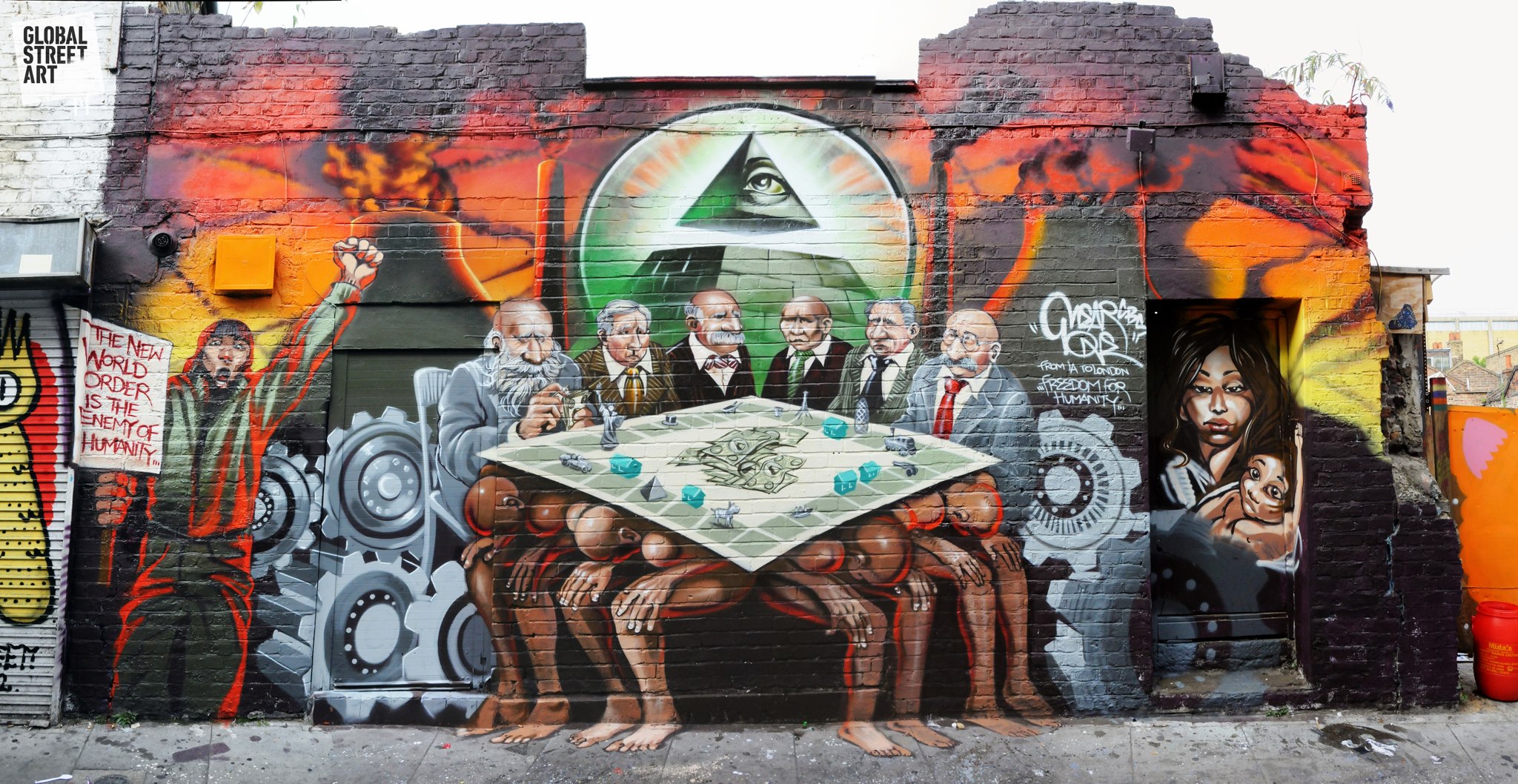
I haven’t seen this mural off Brick Lane in Hanbury Street for myself yet, but Tower Hamlets Tory group leader Peter Golds has fired off a letter to the council’s most senior director Stephen Halsey.

Here’s the mural:

And here is Peter’s letter:

I am horrified at this mural which has appeared on Hanbury Street.

It bears an awful similarity to anti semitic propaganda produced in pre-war Germany.

As well as the anti Jewish overtones, there is even the quasi Masonic (and dollar bill)  aspect to encourage conspiracy theory.

What will be done about the person or persons who has produced this and when will it be removed?

The fact it has appeared over Rosh Hoshanah/Yom Kippur gives added menace.

The history of the mural is detailed on this admiring website here. It seems to have ben painted by Los Angeles graffiti artist Mear One (aka Kalen Ockerman) two weeks ago. He’s described as “political”.

Another website, The Rebel News, has more:

In his latest amazing stop-motion video, the artist creates a mural depicting a group of wealthy businessmen huddled around a monopoly board situated “on the backs of the working class” with a background of the all-seeing eye pyramid and coal and nuclear plants polluting the earth behind them.

Early on several people were expressing their disgust and hatred at the sight of the all-seeing eye, who they said was a symbol of their oppression. Little did they know the artist intended his work to spark conversation, debate and critical thought.

Comments on that site say:
The characters on the two ends of the table are clearly caricatures of Jews – this mural is racist.
A few years ago, Labour’s then environment chief in Tower Hamlets, Abdal Ullah, announced a zero-tolerance approach to graffiti in the borough, including–and he was ridiculed for this–the removal of any Banksy murals.
It’ll be interesting to see what Mayor Lutfur Rahman, who regularly aspires to a ‘One Tower Hamlets’, makes about this latest effort in Hanbury Street, where there is so much proud Jewish history.
There is art, there is politics and there is subtle and overt racism.

Another off-the-beat post, I’m afraid, but sometimes it’s useful to shine a light on the wider workings of journalism and politics–and the symbiosis of the two.

Consider the following national newspaper stories.

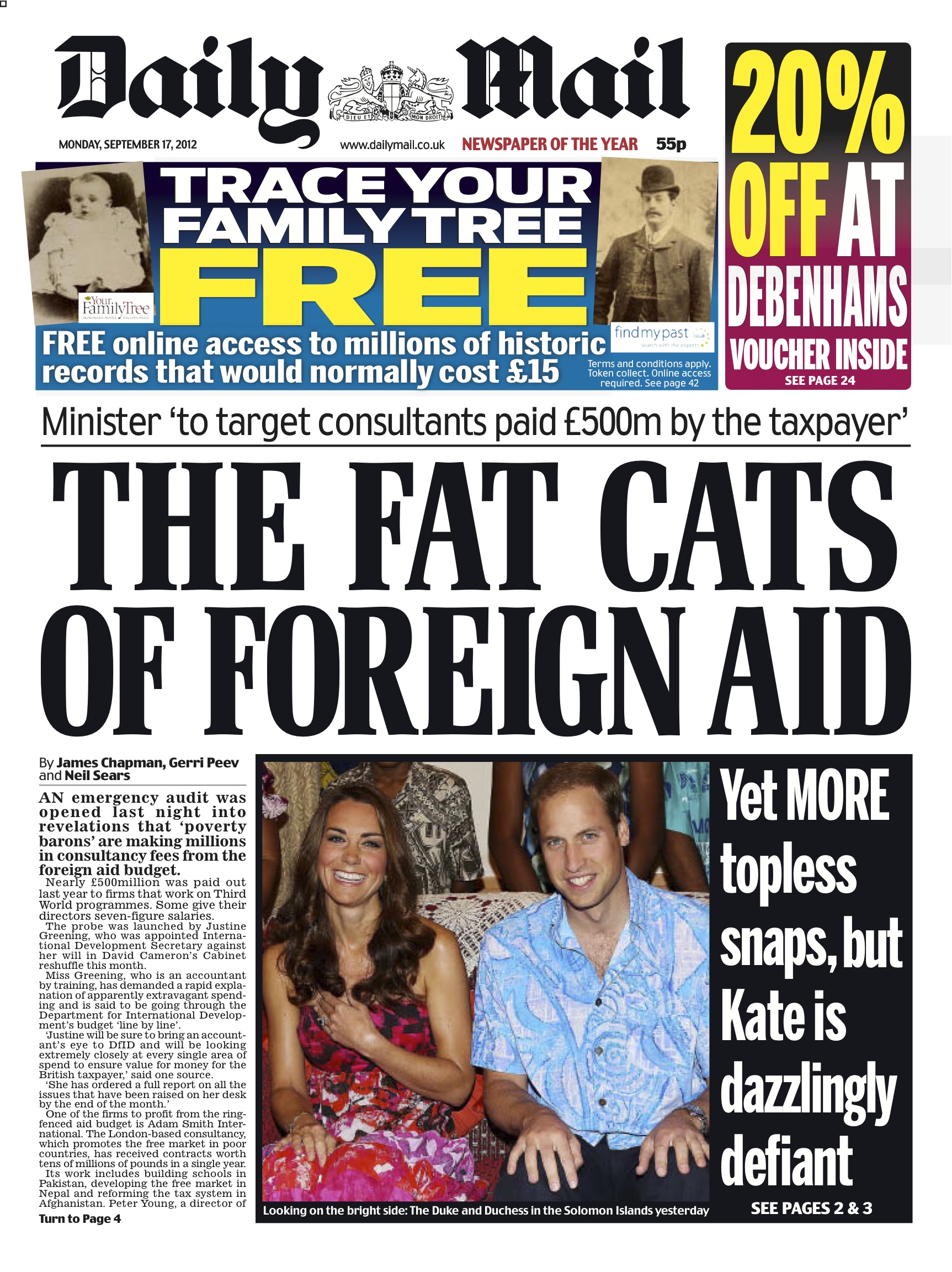
Today’s front page of the Daily Mail:

The Daily Mail’s is about an investigation launched last night by Justine Greening, the new International Development Secretary, after a piece appeared in yesterday’s Sunday Telegraph “revealing” that £500m of DFID money goes to consultants every year.

Here is that piece by Andrew Gilligan on p6 of yesterday’s Sunday Telegraph:

And here’s a front page story by me in the Sunday Express on July 1…11 weeks earlier.

Andrew’s story, in full here, is pretty much the same as mine here. I’d examined 12 months of accounts (May 2011-April 2012) for the Department for International Development and discovered that consultants had been paid £485m to deliver a chunk of Britain’s £10bn foreign aid budget.

I highlighted one company in particular, Adam Smith International, which had received more than £30m in the period and whose four directors had paid themselves £4million in dividends in 2010.

There was almost no political reaction to the story and no other newspaper followed it up…until 11 weeks later, of course.

I had about 500 words to work with. Andrew’s piece yesterday ran to about 1100 words and he was able to add in more detail and colour.

Here’s some extracts from mine:

ALMOST half a billion pounds of British aid money was paid to fatcat consultants last year, while thousands more went to civil servants’ luxury hotels, chauffeured cars, and even acting classes.

A Sunday Express investigation today highlights the scandal of the Coalition’s generous £12billion foreign aid budget, which is ballooning despite crippling austerity cuts across the rest of Whitehall.

Money destined for starving children abroad is either being wasted by civil servants or pocketed by consultants cashing in on the Government’s desire to make Britain an “aid superpower”.

Some charge up to £700 an hour, five times the average annual wage in Malawi, Africa.

More than 1,000 consultancy firms were paid £485million to give “technical assistance” to poor countries between May 2011 and April 2012, according to accounts released by the Department for International Development

…The biggest beneficiary of Britain’s booming aid industry was free trade consultancy Adam Smith International (ASI).

It was paid £30.1million last year to work in countries including Nigeria, Malawi and Pakistan. DfID insists the consultants act as conduits, but ASI’s own accounts reveal that the advice business is also profitable.

Four of its directors shared a £4million dividend in 2010.

Here’s some extracts from The Sunday Telegraph yesterday:

Britain’s swelling overseas aid budget has created a new group of “poverty barons” paying themselves up to £2 million a year for their work helping the disadvantaged.

The Department for International Development (DFID) paid almost £500million last year to consultants, mostly British, many of whom earn six, even seven-figure incomes, courtesy of the taxpayer.

…A Sunday Telegraph investigation shows just how lucrative the aid business can be for the private companies that dominate DFID’s roster.

The managing director of the London-based development consultancy Adam Smith International (ASI), which gets most of its income from DFID, paid himself a salary and dividends totalling almost £1.3million in 2010.

William Morrison earned £200,000 from ASI and collected dividends worth £1.06million from its parent company, Amphion Group, wholly owned by him and three of his fellow directors.

Amphion Group’s accounts state that its purpose is to act as a holding company for ASI.

Mr Morrison’s salary rose by a quarter last year, to £253,000. He and the three fellow directors shared dividends of £7.5million, or almost £1.9million each, which they paid to Amphion Group.

The directors collected salaries averaging £125,000 each.

Adam Smith International — which grew out of, but is now not related to, the Right-wing think-tank, the Adam Smith Institute — was paid £37million by DFID last year to promote the free market in the Third World. Its total turnover that year was £53.6million, with profits of £5million, up 10 per cent on 2010.

An editorial leader in yesterday’s Sunday Telegraph added: “It is notable that it has taken a dogged investigation by The Sunday Telegraph to uncover these payments.”

Well, that’s not quite true is it? Those payments had been uncovered by the Sunday Express 11 weeks earlier.

But in politics and journalism, so much is about timing. My story came at the beginning of summer and in the weeks leading up to the Olympics when attention was elsewhere. But crucially it also came when the Secretary of State at DFID was Andrew Mitchell, a big fan of foreign aid.

The Sunday Telegraph piece couldn’t have been timed better. Justine Greening had just been removed from Transport and dumped into a department she did not want. It is also believed that she is against the ring-fencing of DFID’s budget. So the Telegraph piece was a perfect opportunity for her to set down a marker and make the headlines.

Her decision to launch an investigation is for me the most significant aspect of this. When her predecessor Andrew Mitchell read exactly the same revelations in the Sunday Express in July, he did nothing.

Change ahead for DFID’s budget in the Autumn Statement….?

It’s always a delight when a Freedom of Information request hits the target.

Last February, I wrote this post which listed the small army of personal advisers Mayor Lutfur Rahman had assembled at our expense.

You’ll see there that one his hired hands until that point was a certain Gulam Robbani, who was also Lutfur’s agent in the Mayoral elections in October 2010. He is one of the mayor’s most trusted colleagues, so it was no surprise when Lutfur rewarded him with a consultancy role.

In February, John Williams, Tower Hamlets council’s head of democratic services, detailed the nature of Robbani’s contract. As I blogged at the time, it was as “advisor on adult social care and health for one day per week at a cost of £40 per hour”.

The following month, I wrote this post raising some strange discrepancies between the amounts Mr Williams said Robbani was entitled to and the amounts he was actually getting paid. I reported that between October 2011 and January 31 this year, he had been paid £13,080 under a renewed contract. I noted that this seemed to imply he was billing for far more than one day a week. I also noted that all this was being paid through Robbani’s company, G Social Care Ltd, which likely meant he was paying a lower rate of tax.

Of course, Robbani’s role as a paid advisor ended at his own request from February 1 when it became clear that the long-running saga of Shelina Akhtar’s benefit fraud would provide him with the chance of replacing her as a councillor in Spitalfields, which he eventually did in April.

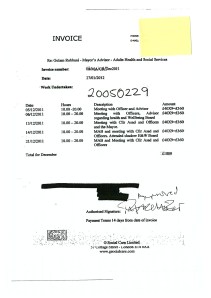
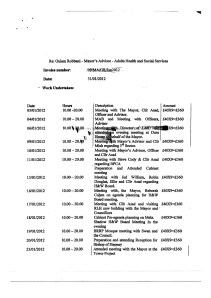
I’ve just had the answer to a Freedom of Information request in which I asked the council for all the invoices submitted by G Social Care Ltd in 2011/12. The full disclosure is here.

These invoices are staggering and I suspect they require some kind of investigation by an independent auditor.

The first thing to note is that all the invoices have been approved and signed off by Murziline Parchment, the head of the Mayor’s office at Tower Hamlets. Parchment features heavily in this blog post by Andrew Gilligan in March last year:

Lutfur has just hired Murziline Parchment, who was among Ken’s notorious City Hall “cronies” during his mayoralty and now becomes Lutfur’s “head of mayor’s office.”

Parchment got this new post without any kind of formal recruitment, interview, shortlisting or assessment process. Although not due to start work until April 1, she is already in the office – and already demanding, according to council sources, to see people’s personnel files.

In her City Hall days, Parchment was one of the eight top Ken Livingstone political appointees on vast salaries who proved so controversial (others included the disgraced Lee Jasper, and several members of the Trotskyite group Socialist Action.) Parchment lost her £126,000 City Hall job after Ken lost the 2008 election – but her pain was cushioned by sharing, with the others, a “severance payment” of £1.6 million.

The Greater London Authority Act specifically stated that as a political appointee her employment was limited to the Mayor’s term of office, meaning that she should not have qualified for a payoff – but, as I documented in 2008, Ken quietly changed the rules not long before the election to ensure that Parchment and the others were looked after. With admirable chutzpah, she also managed to score a further £10,400 “consultancy fee” off the GLA after her departure.

Understandably not short of money, she has spent the last couple of years quietly undertaking various Ken-related activities, such as appearing at his “Progressive London” conferences in 2009 and 2010. But now, thanks to Lutfur, Parchment has another lease of taxpayer-funded life.

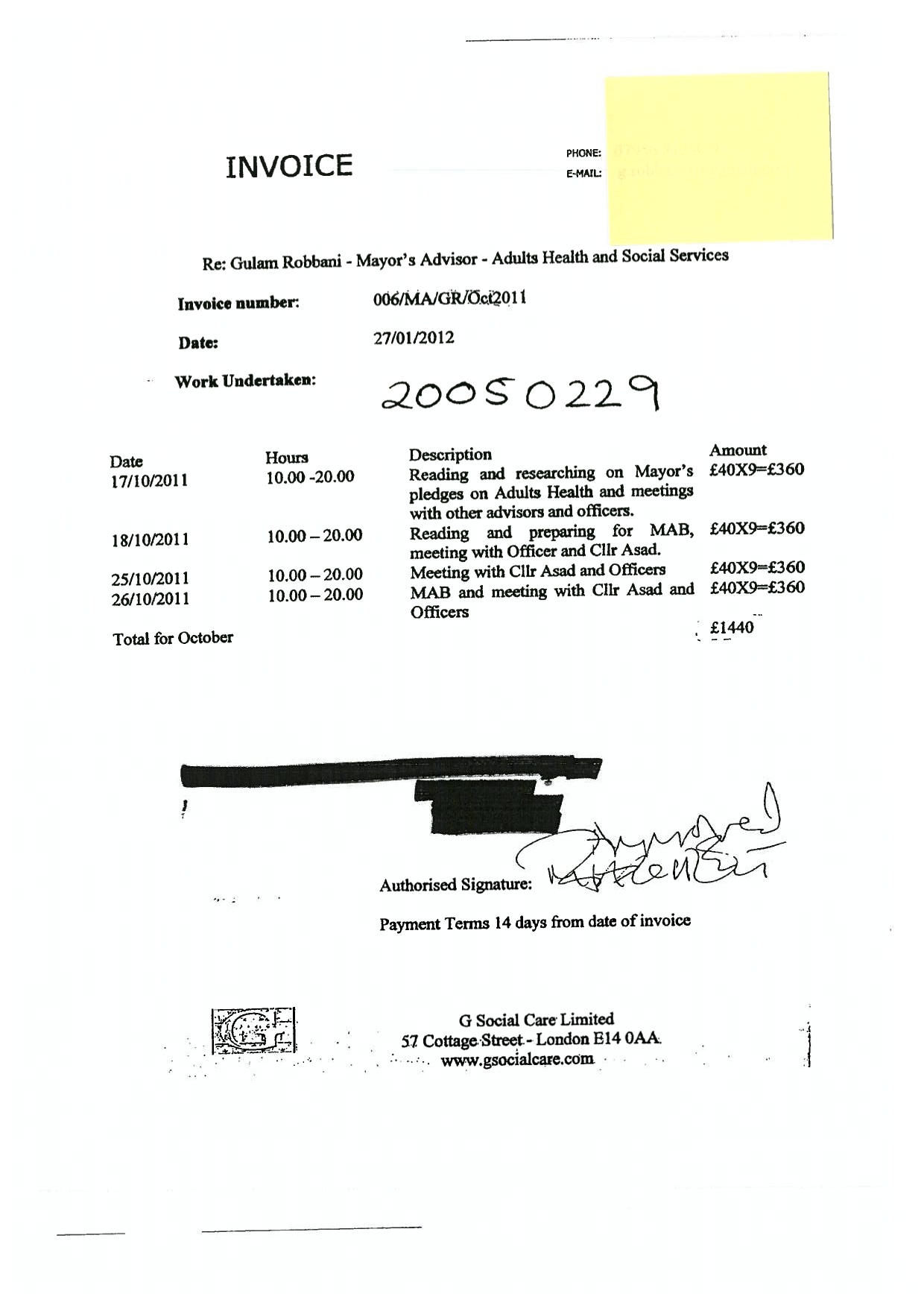
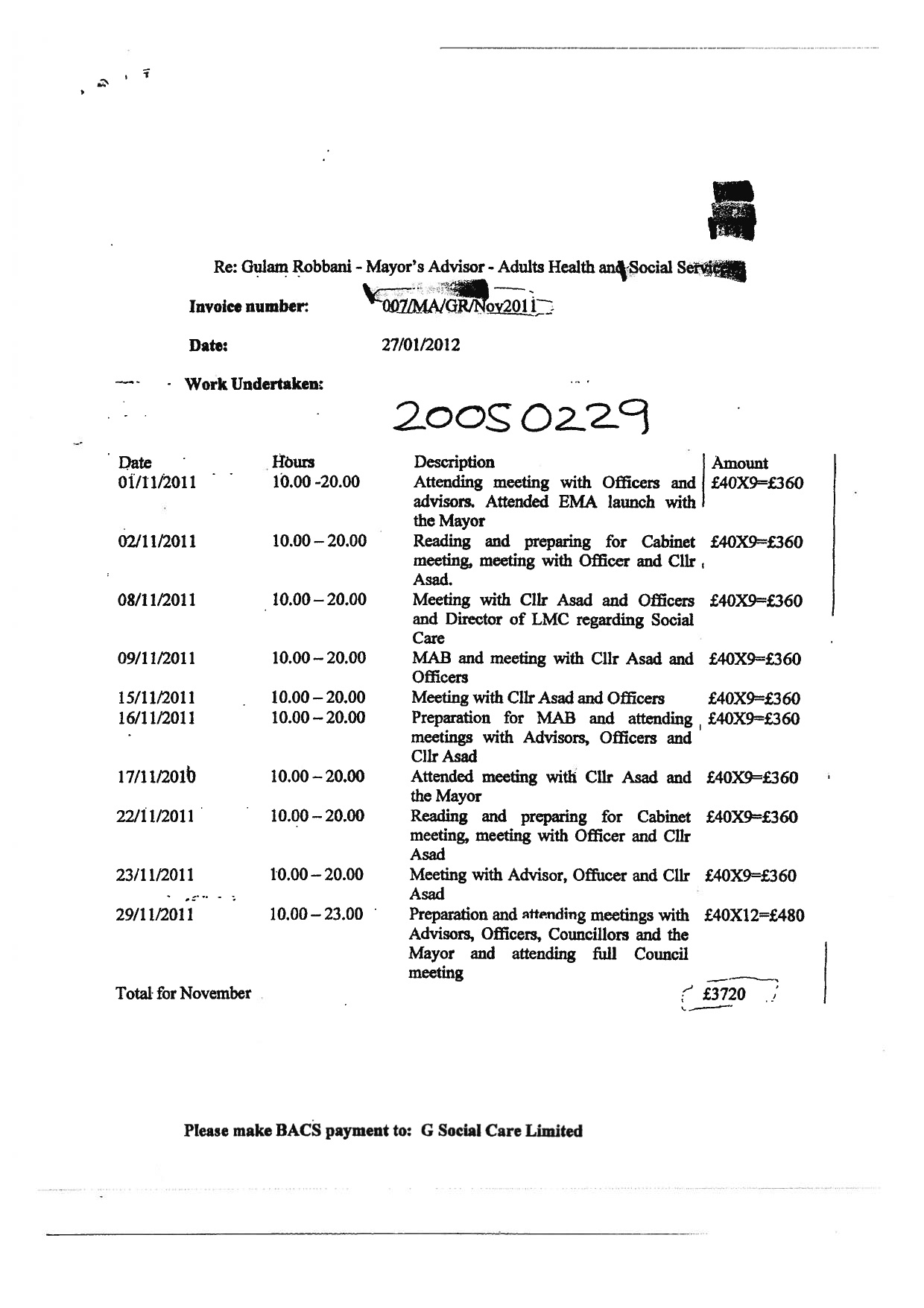
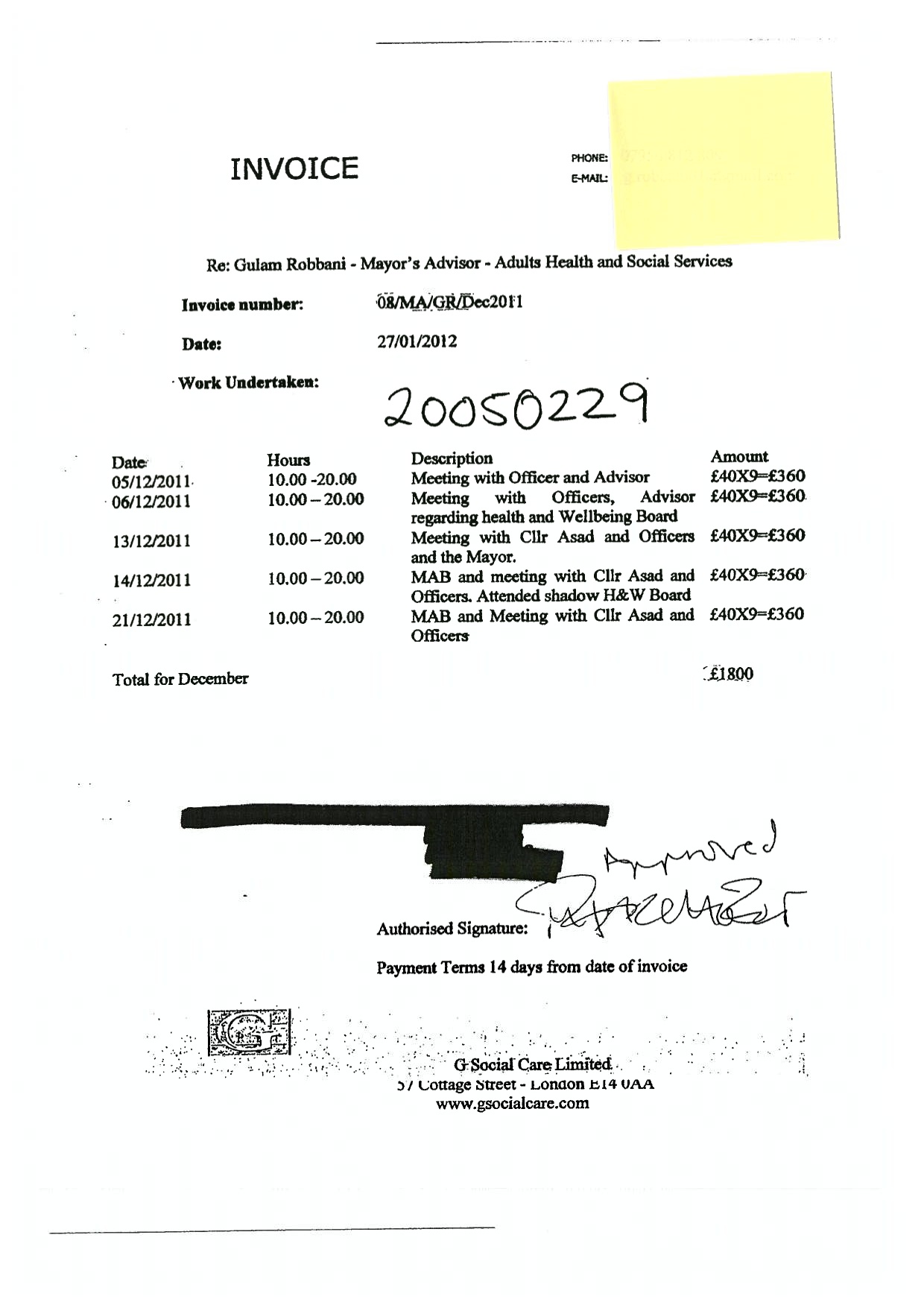
Here are Robbani’s invoices for Nov 2011 – Jan 2012:

In summary, Robbani was billing himself out (with the express approval of his friend and fellow hired hand Murziline Parchment – something that does raise about question of financial control) at the rate of £360 a day. On each item, you will see he has billed for nine hours work between 10am and 8pm, although on a couple of occasions he invoiced longer hours for attending full council meetings.

In October, he invoiced £1440, in November £3720, in December £1800, and in January, just as he was seeing the Shelina/Spitalfields opportunity arise, he put in his final and most lucrative invoice worth £6120.

But it’s when we get into the detail that things get interesting, especially all his “meetings” with Cllr Adbul Asad, Lutfur’s cabinet member for health. In January, he billed for 17 of that month’s 18 working days (a bit more than the one day a week John Williams said he was entitled to – but maybe John got that wrong, I don’t know).

On January 20, he bills £360 for nine hours work described as “preparation and attending reception for Bishop of Stepney”. Well, this is curious because that reception did take place in the town hall at 3pm that day, but it only lasted two hours. How do we know this? Well, Cllr Asad says so on his time-sheet for that month. See here. So that was some “preparation” the adviser on social care was putting in…

In fact, when you cross-check all the claimed “meetings” with Cllr Asad on Robbani’s invoices, there are rarely any matches at all. On Jan 27, Robbani bills us £240 for a “meeting with Cllr Asad” but there is no such meeting on Asad’s time-sheet. Perhaps Asad has been under-reporting his heavy workload.

On January 31, Robbani was paid £360 for a “Health and Wellbeing workshop”, but on Asad’s time-sheet that appears to have lasted just one hour. Maybe Asad left early..

On January 25, Robbani billed £480 for working until 11pm visiting an African Resource Centre and the Mayfield House Somali Day Centre with Cllr Asad and two others. That took 12 hours’ work apparently. Well, Asad registered just 1.5 hours on his timesheet. Maybe Asad put the decimal point in the wrong place.

On January 18, Robbani’s invoice claims £360 for “cabinet pre-agenda planning on Mela and Shadow Health and Wellbeing board meeting in the evening”. It must have been quite some pre-agenda Mela  discussion because Asad tells us Shadow Health and Wellbeing board meeting took just two hours.

And on January 19, Robbani billed £360 for a meeting about the “BRRP mosque with Swan Housing and the council”. Hmm. BRRP is the Blackwall Reach Regeneration Project which will demolish Robin Hood Gardens. That scheme includes provision for a new mosque to replace the existing Poplar Mosque, whose secretary is….Gulam Robbani. So, Robbani was billing the taxpayer £360 to attend a meeting (presumably on behalf of Lutfur, although how that fits in with his brief as a social care advisor beats me) with himself. Some might say that’s a win-win; others might suspect a conflict of interest.

And that’s only part of January’s invoice.

Similar questions arise when you look at the other months. On December 13, for example, Parchment approved a payment of £360 for a meeting with Asad and the Mayor. But Asad has no record of this on his time-sheet.

And have a look at this one from November’s invoice. On Novemeber 2, Robbani claimed £360 for “reading and preparing for cabinet meeting, meeting with Officer and Cllr Asad”. Yes, there was a cabinet meeting that day. On the same invoice, Robbani claims another £360 on Novemeber 22 “reading and preparing for cabinet meeting, meeting with Officer and Cllr Asad”. No, there was no cabinet meeting that day. Did he simply copy and paste the January 2 entry by mistake? Did Murziline Parchment ask that before she signed it for payment? It appears not.

At the very least it’s carelessness and incompetence. How many more payments are senior officers of the council signing off without checking. Did Chris Naylor’s finance team do any checking? Taxpayers deserve better.

These invoices and Robbani’s contract need investigating.

UPDATE

As a result of this post, at the full council meeting on September 19, Labour councillors succeeded in passing an emergency motion calling on the council’s anti-fraud team to investigate these invoices.

Strictly speaking, this is off the topic of Tower Hamlets but as it concerns transparency in public life, there’s more than a slight relevance. Here’s an op-ed piece I’ve written for the Sunday Express today on some lessons from the Hillsborough cover-up. (I’m going to post some fascinating revelations about what could be a spending scandal in Tower Hamlets a bit later today).

HIGH up in a building towering over East London, Metropolitan Police Commissioner Bernard Hogan-Howe addressed a conference on the future of policing.

Before him were many familiar faces: senior police officers, policy makers and business professionals, all eager to hear his views on the coalition cuts and the implications for outsourcing and community policing.

The timing of Friday’s Canary Wharf meeting was interesting. 

Two days earlier policing in this country suffered one of its darkest days when David Cameron delivered revelations about the Hillsborough tragedy, so shocking they reduced not only several MPs in the Commons to tears but also some journalists in the press gallery. 

The PM’s sincere words about a cover-up by police and others in high office had landed like dull, heavy blows to the solar plexus, shaking people’s faith in the cornerstones of our democracy.

So sitting there in Canary Wharf I was half-expecting Mr Hogan-Howe, a former Chief Constable of Merseyside, to make some reference to those events of 1989 and to how policing and more pertinently the scrutiny of policing had moved on.

But no, not a word.

Fair enough, I thought, the conference was more about looking forward than back and his speech on the scheduled items was robust, refreshing and well received.

As he was leaving I approached him in the corridor. I wanted to explore whether the Hillsborough cover-up confirmed the suspicions among some that the police would always try to hide their own errors.

If they could doctor the evidence on the deaths of 96 people in a high-profile tragedy was that not playing into the hands of conspiracy theorists who believe it happens all the time, I wanted to ask.

“It was 23 years ago, we should be confident in our policing today,” he said.

A couple of hours later I asked the question to Shami Chakrabarti, the director of Liberty who was at the conference. Her response was more expansive.

She said: “Hillsborough is one of the most horrific stories of secrets, lies and abuses of power in my lifetime and not just the police but all sorts of powerful institutions need to do some serious soul-searching. It also demonstrates the danger of the current Bill going through Parliament to introduce secret courts.

“The last thing we need is secret courts and we’ve just seen how easy it seems to be to cover up huge abuses of power.”

Shami was referring to the Justice and Security Bill that allows sensitive material in criminal trials to be heard in private and is now in the latter stages of Parliament.

Yes, 23 years is a long time ago. Yes, the circumstances surrounding Hillsborough have changed and yes, policing has moved on but has human nature really altered?

In all walks of life there is the temptation to cover your back and in far too many circumstances we’ve probably all seen people trying to lie their way out of errors. In public office the offence is far graver.

Over the past 18 months I and a sadly small handful of other journalists have covered some of the failings of our Family Court system, which until relatively recently was largely closed to the public. 

I’ve spoken to social worker whistle blowers who have been told by their bosses to “sex up” dossiers on problem families so local authorities intent on removing children for adoption purposes can have an easier ride in front of judges.

Leading academics have uncovered fundamental problems in the system of expert witnesses used by Family Courts to assess the mental health of natural parents.

A close British friend of mine had her 14-month-old baby removed from her by a judge in Spain based on the wrongly translated assessment of a junior court-appointed psychiatrist.

In other cases I’ve worked on, pregnant mothers have had to flee the UK to have their babies as they have so little trust in the “secret” court system.

It’s not just courts. Anyone who has had to fight their local council to disclose documents under the Freedom of Information Act will also know just how much our bureaucrats love their work being hidden.

The fact is that transparency works. Tony Blair is to be congratulated for having started the process with the FoI Act… and condemned for later regretting it.

Likewise Mr Cameron’s transparency agenda, which forces public authorities to publish spending transaction details, is another welcome step forward.

Shining a light is the healthiest of medicines when it comes to holding our leaders to account.

Last year MP John Hemming came under fire for breaking a super-injunction secured by footballer Ryan Giggs, who had been having an extra-marital affair.

Hemming is also at the forefront of campaigning for more transparency in Family Courts so is well qualified to talk about secret justice. 

This is what he said yesterday: “Whereas the police who perjured themselves in the Hillsborough case can be prosecuted it is difficult to prosecute people who lie in secret courts. The evidence in secret courts is unreliable.”

The ramifications of Hillsborough are huge. Cover-ups have happened and the blame process begins but one of the greatest lessons to be learned, especially for the police, is that the long arm of the people’s law will always get you in the end.


Well, well, well…we were perhaps a little too quick to question the resolve of some at Tower Hamlets council to stand up to Mayor Lutfur Rahman’s self-styled financial backer Shiraj Haque.

So hats off to Stephen Halsey, the council’s director of Communities, Localities and Culture Directorate at Tower Hamlets council (and who is also the current Head of Paid Service, pending the ongoing fiasco to hire a permanent chief executive.)

For, only a year after handing millionaire housing association tenant Shiraj control of the lucrative Baishakhi Mela, Halsey’s trading standards and environmental health enforcement teams have managed to force a significant guilty admission from the Brick Lane curry king.

Remember this story from Andrew Gilligan in August last year, when he revealed police had raided Shiraj’s restaurant empire and found his Clifton and Shampan restaurants had been selling relabelled wine?

Well, a series of obscure documents on the council’s licensing sub-committee website tells us the full extent of that investigation…and the outcome. See item 4.2 , “An application to review the premises licence for Shampan Tandoori Restaurant at 79 Brick Lane.

The committee was due to meet on August 30, but the hearing was postponed. Yes, Shiraj could lose his licence, but the damage is already done.

You’ll see on pages 5 and 6 of this document that on July 16, just as Brick Lane was gearing up for its prestigious role as Curry Capital 2012, its most prominent businessman was humiliated by being forced to accept a caution for selling the relabelled wine.

Here’s his signed admission:

The admission that he was selling cheap Italian plonk that had been relabelled as higher strength and presumably more expensive Australian shiraz (I wonder if he intended the pun) could be real trouble for him. It is not a criminal conviction but his name is now on a national convictions database, meaning it will show up in any criminal records bureau/CRB check.

It gets worse. The other documents that have been prepared for the licensing hearing show the full arrogance of Shiraj’s Clifton empire. Last December, the same committee voted to suspend his premises licence after undercover police were approached by touts working for his Shampan restaurant.

That week-long suspension (ie enforced closure of his restaurant) ran from July 9 t0 midnight on July 15. But it seems that for the past year, Mr Halsey’s teams and the police have been keeping a close eye on Shiraj’s activities.

On December 21, a few days after his plaintive appearance at the licensing committee, his Clifton Express supermarket in Westferry Road on the Isle of Dogs was selling booze to what turned out to be an underage police cadet.

And on July 14 and July 15, right in the middle of the supposed trading ban, Mr Halsey’s Tower Hamlets Enforcement Officers (THEOS) were dispatched to watch the Shampan restaurant and on both days saw it selling hot food. Shiraj accepted his dodgy wine caution the next day.

Other documents list allegations that his restaurants have continued to tout and harass customers, and therefore breach important council bylaws. One magistrate court case against a staff member Shiraj subsequently sacked is pending.

The full documents can be read here.

If the licensing committee considers these continuing breaches as significant as I suspect Mr Halsey’s team does, Shiraj could well be deemed not fit to hold a licence.

And if that becomes the case, surely he would be unfit to run his beloved Baishakhi Mela. And if that were the case, what would Lutfur say?

As I’ve said before, it’s about the company you keep…

Two bits of Bank Holiday weekend fun for you.

1. Peter Golds has pointed out the irony of this post nine days ago on Axel Landin’s Mayor Lutfur Rahman’s blog. It’s headlined “Bring Back British Rail” (the author was clearly too young to remember BR):

Yesterday saw a national day of action by transport unions and passengers to protest fair (sic) hikes and service cuts across the railways. I salute them. British train passengers already pay among the highest fares in Europe for train travel and now the government has announced that train operating companies will be able to increase rail fares by three per cent more than inflation. 

For the last two weeks we have seen government figures in Westminster and London figures basking in the borrowed glory of the Olympics that their Labour  predecessors secured for city and the country.

One tangible related benefit of that much touted but hardly touched Olympic Legacy has been the development of transport links across the previously cut off poor areas of East London – and on its way is the Crossrail link which ties in the area to the greater region.

And now it is back to dismal normality with the announcement of 11% rail fare rises.  We will indeed be better linked to the rest of the Capital and the world. But far too many of our citizens will not be able to afford the tickets.

It is going to mean price hikes on rush hour travel, season tickets and on off-peak fares on the majority of intercity journeys. Passengers will get worse quality and less safe service for their higher fares. 

This is all a direct result of rail privatisation. As we saw with the spectacular failure of G4S Security, the conservative idea of so called “private enterprise” is to take national and civic assets, milk them with subsidies, dividends and bonuses, and then call upon the public sector to rescue them from the consequences of greed and imcompetence. One study “Rebuilding Rail, Transport for Quality of Life” shows that rail privatisation costs over than £1bn a year. 

During the Olympics, we saw that the rail infrastructure was already running close to capacity. But despite that the success of Ken’s policies, like the Oyster Card, the bicycle lanes and the congestion charges had kept people off the roads and carbon dioxide out of the air.

We need more investment in public transport, cheaper fares to coax more passengers out of cars – and less money for bonuses. As the RMT’s Bob Crowe says “The campaign to Bring Back British Rail is an idea whose time has come.”

Peter was particularly struck by this paragraph (my emphasis):

During the Olympics, we saw that the rail infrastructure was already running close to capacity. But despite that the success of Ken’s policies, like the Oyster Card, the bicycle lanes and the congestion charges had kept people off the roads and carbon dioxide out of the air.

Oh yes. But of course Ken’s policies haven’t been that successful, have they?

That’s the infamous E-class Mercedes Lutfurmobile that the Mayor hires at our expense for £72 a day. Yes, it does spew out carbon dioxide.

And…

2. Walthamstow MP Stella Creasy in a tweet tonight has highlighted a fascinating data-map of London based on common surnames. It has been produced by James Cheshire, a geography lecturer at University College, London. On his website here, which I thoroughly recommend clicking through to, Cheshire shows how surnames cluster themselves in various parts of London. You can scroll into Tower Hamlets districts and see the concentrations of Rahmans, Uddins, Browns, Smiths and Khatuns for example.

Here’s a flavour….have fun.


The phrase ‘Olympic legacy’ is understandably all the rage at the moment. Indeed, Mayor Lutfur Rahman has used it as a pretty weak hook for an article about housing and Government cuts in the Huffington Post today. It’s here.

If he (or whoever writes his pieces for him) had been a bit cuter, and possibly a bit more knowledgeable about what goes on in Tower Hamlets, he could have boasted instead about how a handful of the borough’s schools are leading the entire country when it comes to delivering a true Olympic legacy, one that genuinely harnesses the power of sport to do good.

For at George Green’s School on the Isle of Dogs and at Raines Foundation School and Morpeth School in Bethnal Green, the lives of probably thousands of kids are being transformed via a pioneering coaching initiative run by the marvelous Greenhouse charity.

Greenhouse, which is run by ex-accountant Michael de Giorgio (see, we are a special breed..), places inspiring coaches in inner city schools with the aim of not only improving children’s sporting prowess, but also – and more importantly – of using sport to make them better people and more employable.

Would you believe that Tower Hamlets youngsters are now amongst the best table tennis players in Britain? I saw an exhibition of the Morpeth kids in action when the Queen visited Millwall fire station few years ago: they were breathtaking.

[Of course, it’s particularly ironic that George Green’s is one of the schools doing so much good in this area. Last April (see here and here), its headteacher, Kenny Frederick, warned Lutfur and his cabinet spokesman for education Oli Rahman that their completely uncosted decision to take youth services back under the bureaucratic and historically failed control of the town hall risked returning the Island youth to street gangs.]

The Greenhouse charity is so well thought of that Prince William, Kate and Prince Harry, via their new Royal Foundation of the Duke and Duchess of Cambridge and Prince Harry, last month backed its Coach Core pilot scheme, which will roll out nationally if successful.

I wrote about it for the Sunday Express here; it is worth a read.

And I thought I’d use this blog to highlight another piece that appeared in the Sunday Express last week, this time by Greenhouse’s Michael de Giorgio. We asked for his thoughts on the Olympic Legacy for school sport. It would be brilliant if Lutfur could write about the Greenhouse’s work in one of his East End Life columns sometime soon.

Here it is:

THESE are the Games that promised to “inspire a generation”. Over the past 17 days, they have done so.

The promise of the Games was not just to deliver a festival of sport, however, it was about creating a sporting legacy for young people inspired by the likes of Jessica Ennis and Mo Farah.

With that generation now inspired, are we ready to deliver the promised legacy?

I’m afraid the answer is “not yet”.

Grassroots sport is not in a good place. Top of the agenda are cuts to school sports and the Sports Minister’s admission that considerable spending on raising sport participation has failed.

Introducing a school games competition is a sticking plaster that is fooling no one.

To start to put this right we need to start to change how we think about sport.

Our Sports Minister’s remit is to win medals and get the maximum number of people playing.

The former has been a resounding success, while the latter has not.

Measuring the role of sport and making funding decisions based on these two measures greatly undervalues the role sport should play in society.

Raising sport participation is failing because the quality of the experience received by the child through these schemes is not good enough. The funding system rewards those providers who claim they can reach the most people. If your focus is volume alone, quality will be poor.

We need to spread the funding less thinly. Current government thinking is to target 14 to 25-year-olds. That is simply too late in a young person’s life.

We need instead to concentrate funding on the most disadvantaged communities, where sport can make the biggest social difference.

Secondly, we need to develop our coaches to have a greater influence on young people. We can follow the lead of the Duke and Duchess of Cambridge and Prince Harry on this point, who through their Royal Foundation, have worked with us to set up Coach Core.

The scheme not only trains coaches to be good technical coaches, but also mentors and role models who can engage and develop young people.

This approach needs to be adopted widely if sport is to make the difference it can.

These principles of focusing on disadvantaged communities and using coaches to develop young people are used by several charities, of which Greenhouse is one.

We place coaches full time, spending an average of five hours a week with each young person, setting very high expectations.

The young people are out-behaving, out-attending and out-performing their school peers.

They are fitter, healthier and the risk of them being drawn into crime is greatly reduced.

However, in a system which rewards organisations that promise thousands of attendees, but deliver no real benefit, charities like ours remain the exception rather than the rule.

We were promised a better legacy than this.

Oh dear. What should have been a straightforward farewell ceremony to the troops who had been stationed at Tobacco Dock in Wapping for the Olympics has turned into sour political row.

Mayor Lutfur Rahman, alongside Dame Helen Mirren, was given the honour of inspecting the military on Sunday in Wapping Rose Gardens.

Here they all are together.

Thanks to Wapping-based Baynes Media, we have a video of the event in which Lutfur’s young political adviser Axel Landin can be seen trying to scare the hell out of the soldiers by jumping up and down behind them with a camera at 1minute or so in.

After making a gracious speech thanking the Armed Forces for their efforts and then inviting them all to eat a curry that someone in Brick Lane had laid on for them all (who, I wonder..), Lutfur retired home, rested overnight and wrote an account about his experience for his blog on Monday. The full blog post is here.

Again, the bulk of it strikes the right tone, but then this:

There was unfortunately one sour note. As this was a civic occasion for all of our borough, I naturally invited the leaders of the other groups on Council, Joshua Peck (Labour Group) and Peter Golds (Conservative Group) to join me at the event in paying tribute to the efforts of our servicemen. They did not turn up.

I very much regret that our opposition leaders chose to absent themselves from this very moving ceremony. I sincerely hope that their discourtesy to our armed services, and indeed to our borough, will not prevent them from supporting the Covenant our borough has announced to ensure fair treatment for returning veterans.

Well, this is pretty rum. Someone I know who is an officer in one of the regiments who served at the Olympic Park believes these comments to be disrespectful to the soldiers. A gracious farewell event should be apolitical. Trying to make political capital out of this is fairly low grade.

Josh Peck tells me the invite to the event was only sent ou by Communications head Takki Sulaiman at 6pm on Friday, and even then only as a round-robin to all councillors. He says he had a long-standing family commitment that he just could not alter. I’m sure our soldiers, of all people, would appreciate the importance of family events.

Peter Golds, who has an OBE and from what I have seen takes more pride in such civic duties than most, has gone further. He was unable to attend because every Sunday he travels to look after his severely disabled brother. Again, I’m sure the troops, more than most, would understand the value of this.

Peter said:

It is a slur to suggest that Iwould show anything but utmost respect to our armed forces and had I been given notice about this event I would have attended. In fact notice was sent out at 18.14 on Friday evening. I have written to [Royal Navy Regional Commander] Commodore Atherton and also to Lutfur Rahman requesting that his blog be amended. I have also asked questions as to the timing of the arrangements via members enquiry and freedom of information. 

This is his letter to Commodore Atherton:

Dear Commodore Atherton

On behalf of my group colleagues and local residents I am writing to express our thanks for the work that our service personnel put into the Olympics. Always cheerful, never failing to respond to requests for directions they were a credit to our city and country.

As reported in the East London Advertiser, your reception at the parade in Wapping on Sunday showed how much locals appreciated the work put in by our Forces.

I would like to apologise personally for not being present to pay my personal thanks. Sadly, Tower Hamlets Council notified members late on Friday afternoon and like many council colleagues I did not see the email until too late.

I know from residents who did attend, that you were given a rousing reception and I hope that this short letter adds to the cheers.

And this is the letter to Lutfur:

Dear Mr Rahman

Re: Your “Blog” – Thanking our armed forces for their Olympics Service

I have today written to Commodore Martin  Atherton regarding the Parade on Sunday in light of your blog, which is accessed via the Council website and therefore can be construed as official and certainly more than the ramblings of a politician.

The blog makes an untrue and dishonest statement regarding me which I quote directly:

“I very much regret that our opposition leaders chose to absent themselves from this very moving ceremony. I sincerely hope that their discourtesy to our armed services, and indeed to our borough, will not prevent them from supporting the Covenant our borough has announced to ensure fair treatment for returning veterans”.

Notification of this event was sent to me by your Head of Communications at 18.14 on Friday 10th August using my normal council email address. I did not open this until late on Saturday – far too late to make arrangements to attend.

It stands to reason that arrangements for this would have taken some time and therefore members could have been given an indication of the time and venue before all details were finalised. I find it difficult to accept that the very late notification was anything other than intentional.    

I will be raising questions with regard to this blog but expect that you will alter this untrue story and provide me with a right of reply in case anyone should be misled. 

Unfortunately, Lutfur does not allow comments on his blog. If he did, I’m sure someone would have raised another civic occasion at which respects are paid to the military when another senior member of the council failed to show turn up…one which is marked in the calendar every year…

Remember the Remembrance Sunday Service in November 2010? Yes, the missing man on that occasion was a certain Mayor Rahman. His surprise absence apparently even baffled then council chief executive Kevan Collins. He warned no one he would be missing, I’m told.

Perhaps he was just out for revenge when he wrote his blog. Very silly, very student politics. He can do better than that.

Strictly speaking, this post is off the politics beat but it’s a topic that needs the energy of a brave, campaigning politician to take forward. They, and anyone else who has information about the following police investigation, including former or serving Tower Hamlets police officers, can contact me anonymously/confidentially, via the contact details on this blog.

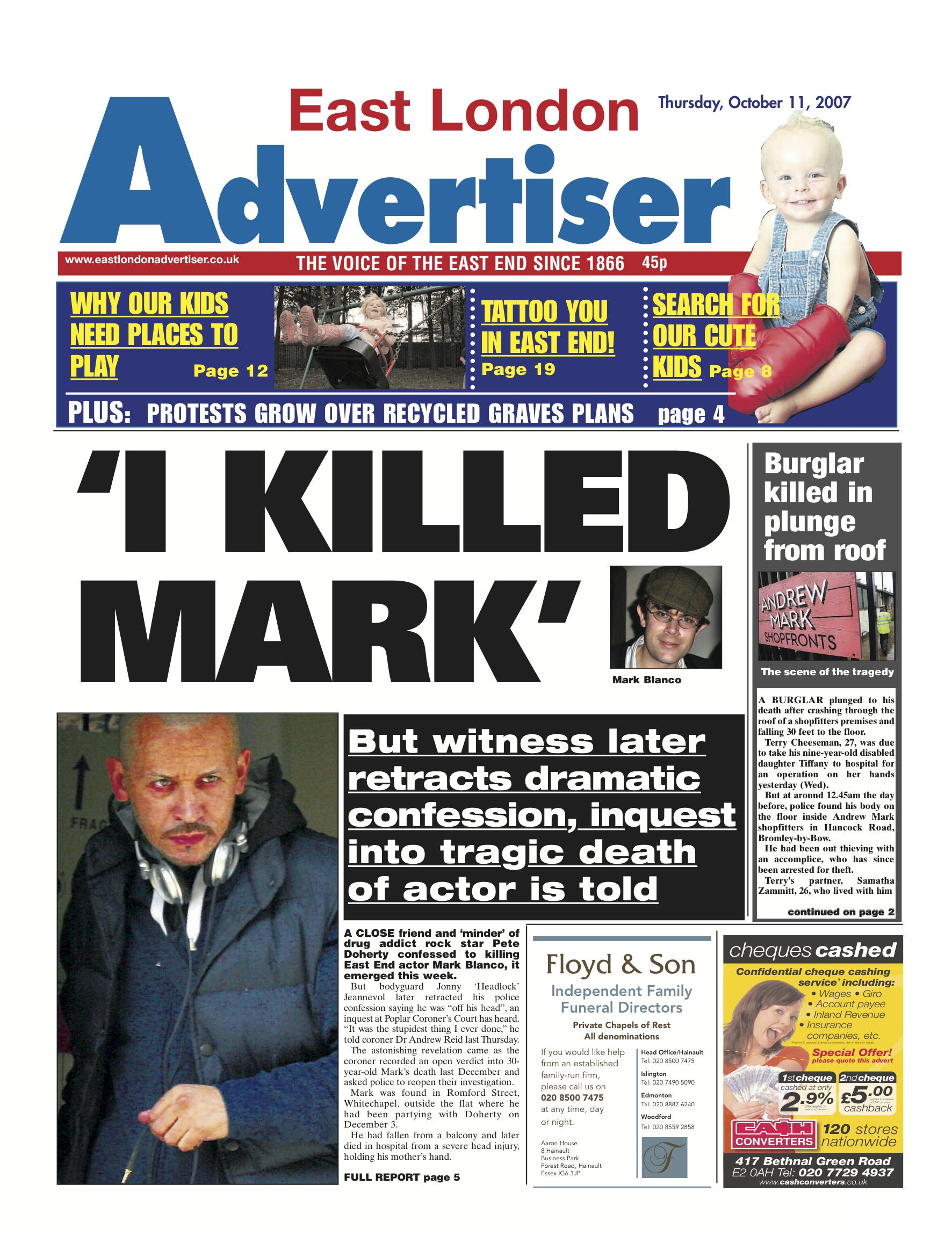
Of all the brilliant front pages produced by my former editor at the East London Advertiser, Malcolm Starbrook, these two are among the ones of which I am most proud.

The first was published on the first anniversary of the death of 30-year-old Mark Blanco, who fell in highly dubious circumstances from a first floor balcony in Romford Street, Whitechapel, in December 2006.

The second was published in October 2007, the day after a coroner halted an inquest into Mark’s death and dismissed out of hand the conclusions of a shockingly shoddy police investigation conducted in Tower Hamlets that suggested Mark had either killed himself or died as a result of an unexplained accident. At that inquest, Johnny Jeannevol – better known to his friends on Exmouth Estate in Stepney as Johnny Headlock, the diminutive hard-nut “minder” to Libertines frontman Peter Doherty – admitted he had confessed to murdering Mark by single-handedly throwing the bulky 6ft 4ins Cambridge graduate over the first floor railings…only later to retract his words.

Mark had been at a small gathering of people at a top floor flat in Romford Street hosted by slippery Paul Roundhill, who styles himself as a “literary agent”, but who is better known as a drugs agent for  Doherty (and who has been linked to Kate Moss in that regard). A post-mortem revealed Mark had been drinking but there were no traces of drugs in his body. The post-mortem also revealed injuries to his head that were consistent with being punched, something Roundhill confessed to doing at the inquest. The suspicion is that Mark was thrown over the balcony by more than one person, possibly not with murderous intent (the drop was 11ft and there was a parked car directly below), but certainly recklessly and with murderous consequences.

Here’s the balcony:

I’ve been investigating this for several years, but the expert is Mark’s wonderful mother, Sheila, who lives in Guildford, Surrey. If it hadn’t been for her tenacity or for the brilliance of her pro bono barrister, Michael Wolkind QC, there would not have been a second police investigation by the Met, something ordered by the coroner in 2007.

Not that the second police investigation achieved anything. Like the first, some of Britain’s supposedly finest detectives were unable to exact anything from Doherty’s conveniently blurry memory, or produce anything the CPS could use for a prosecution.

I will not go into the exact details of the case and circumstances here, but anyone wanting to get a flavour of them can do so from this 2009 Sunday Express article in which we showed for the first time the CCTV footage of Mark’s death, with a falls expert later concluding it was probable he had been deliberately pushed.

There are lots more details on the Justice for Mark Blanco website here and the fascinating Sky News interview with Headlock can be seen here:

Doherty always did have a close relationship with Tower Hamlets police, having been arrested by them several times for relatively minor drug offences while driving through Bethnal Green (and, as an aside, I was always curious how The Sun and the Daily Mirror always managed to report those arrests first and ahead of the Advertiser when they never attended any police press briefings in Bethnal Green: maybe they had useful unpaid contacts in the custody suite at Bethnal Green…). Surely, our police weren’t star-struck?

Earlier this year, Doherty said he felt “ashamed” about having run over Mark’s dying body to flee the scene that night, but he insists it was all an accident and that he is hiding nothing. Perhaps, then, he would like to give permission for the transcript of his interview with the police to be made public?

And there are also questions about Roundhill’s relationship with the police. At the time of Mark’s death, it was rumoured in the area that he was a very useful police informer (something he always refuses to discuss with me). And at the time, cracking down on crack houses and drug dealers was the number one priority for Tower Hamlets police, as directed by the council’s then lead member for community safety, Abdal Ullah. Join those two facts up, Mark’s friends and family suggest, and you have a possible but unproved explanation for the way in which the police seemed to make up their minds so quickly on what happened. Cock-up or conspiracy. I nearly always tend towards the latter when that question arises.

The detective in charge of the investigation was DI Mark Dunne. Despite the failings of his investigation, he has since been promoted to Detective Chief Inspector and appears on the BBC Crimewatch programme.

So Sheila’s anger is understandable, on many levels. She has just lodged a petition on the Change.org website here which calls for justice for her son and for reform of the “institutionally incompetent and corrupt Met Police”. I hope some of our councillors, particularly those who represent Whitechapel (Lutfur Independents Shahed Ali, whose cabinet responsibility includes policing, Abdul Asad and Aminur Khan) will be brave enough to sign it –  that would make a powerful statement. The media focus on this issue is about to intensify.

Here are Sheila’s remarks on the Change website:

JUSTICE FOR MARK BLANCO

I, Mark’s mother, Mark’s family and friends urge the Met Police to ‘discover’ Justice: to answer the many outstanding questions about the death of Mark Blanco, to conduct a transparent, robust investigation and uncover the facts. WHAT CAUSED MARK TO FALL TO HIS DEATH JUST MINUTES AFTER AN ALTERCATION WITH PETE DOHERTY AND HIS ASSOCIATES?

We are fighting for Justice for Mark Blanco who has not yet received a fair, open-minded and thorough police investigation, though he was unlawfully killed nearly six years ago. Mark, the victim, no longer has a voice,BUT we have. Much of the investigation into Mark’s death I have had to carry out myself. Should Justice in this country have to depend on the tenacity of a mother?

PLEASE SUPPORT THIS CAMPAIGN AND HELP TO BRING ABOUT CHANGE IN THE INSTITUTIONALLY INCOMPETENT AND CORRUPT MET POLICE. PLEASE JOIN US IN DEMANDING JUSTICE FOR MARK.We are convinced that Mark, a 30-year-old Cambridge philosophy graduate was killed – bundled or thrown over a 4′ high railing of a first floor balcony to his death.

On 3rd December 2006, my son, Mark, fell to his death from a balcony just minutes after an altercation with Pete Doherty and his associates, Paul Roundhill, Doherty’s drug supplier, and Johnny Jeannevol, better known as ‘Headlock’, Doherty’s minder. Mark had been punched, his clothing torn and his cap set on fire before he was evicted from Roundhill’s flat. Doherty, Kate Russell-Pavier and Headlock came down, almost stepped over Mark as he lay dying in the gutter and ran off to a party. Three weeks later, Headlock walked into Bethnal Green Police Station and confessed to Mark’s murder. Later, he retracted that confession and the Met Police investigating officer, DI Mark Dunne, did not think it worthy of a SINGLE mention in his report to the coroner. Dunne told family and friends that Mark had committed suicide (as his own brother had done), that Mark was blind drunk, that he had jumped, none of which were true. Why did he make blunder after blunder? Was it just negligence? (Dunne now promoted to DCI Dunne)

Michael Wolkind QC offered his services and it was his brilliance at the Inquest in October 2007 that turned the case round. An open verdict was declared and a police re-investigation into Mark’s death ordered.

From the outset, the first Met Police investigation was shoddy, incompetent, pre-judged and incomplete: the scene was never cordoned off and the scene was closed at 04.19 as ‘there is no indication that this is suspicious.’ Witnesses were questioned haphazardly and no forensic examinations were carried out on Mark’s clothes, nor was any DNA taken. I found the lens from Mark’s glasses in the gutter more than 24 hours after the incident happened and after Mark had died from his injuries.

The version of events given by Roundhill, the one-time literary agent to Doherty and his drug supplier, were those accepted by the police. It is also well chronicled in the area that Roundhill is an informant. In the words of Michael Wolkind, “Common sense tells us this is an unlawful killing yet the police allergy to crime in this case is extraordinary.” The second police investigation by the Homicide and Serious Crime Command showed further reluctance to interview the three men, Doherty, Roundhill and Headlock as witnesses and/or suspects. Hours of police time have been spent in trying to exonerate these individuals. Is this more than celebrity privilege? For them it is business as usual, bragging about what happened on that night at Roundhill’s flat.

Mark died from multiple skull fractures, with no injuries to his limbs .He used no protective reflexes to protect his head, which is normal in a fall. In 2008, I commissioned Injury Biomechanics experts to examine the way in which he fell. Richard Wassersug, Professor of Anatomy and Neurobiology concluded that: “Given Mark’s injuries, the two most likely explanations are that he was backed into the railing and pushed over, or that he was not conscious, and was dropped over the railing.” The Met response to the experts’ findings; “We do not consider biomechanics to be of assistance in this particular investigation.”(DS V Rae)  I was told that I would never know how my son was killed.

December 2009, I put Mark’s case before Anne Milton MP for Guildford, who passed it to the Home Secretary, Commissioner of the Met and the Attorney General’s Office. In July 2010 I submitted ‘Flaws in the Met Police investigation into Mark Blanco’s Death’ to the CPS (Crown Prosecution Service). May 2011: “CPS London has decided there is insufficient evidence to charge any individual with either murder or manslaughter in relation to the tragic death of Mark Blanco in December 2006.” Given the quality of the initial police investigation, crucial evidence was lost or not taken into account. Was this a case of incompetence, celebrity privilege and/or corruption?

Following consultation with the legal team, I compiled a further dossier, submitted to the IPCC (Independent Police Complaints Commission) in July 2011. I understand that work on this is in progress.

PLEASE SIGN OUR PETITION AND MAKE OUR VOICE HEARD

Thank you

Sheila Blanco

To mark the Closing Ceremony, today, dear readers, I present to you a guest post by Michael Keith, the former leader of Tower Hamlets Council who is now a professor specialising in migration studies at Merton College, Oxford.

His post is a follow up to my piece here last month (The Tower Hamlets population boom: is it all bad?) on the early results of the 2011 Census data. Michael wrote to me with some comments and he agreed it could be used as a separate piece:

I was impressed by the points in the blog post but also thought people might want to think about the following:

A few points to note about the recent release of the first results of the 2011 Census for Tower Hamlets.

1. If the first run ONS data is correct in suggesting LBTH population in 2011 is approximately 254, 000 from a figure of 201, 000 in 2001 then this returns the population numbers in the borough to roughly the level it was in 1950.  If you look at the following consolidated table for Tower Hamlets population trends longer term it highlights that from 1800 to 1900 the area that we now call Tower Hamlets had a population that grew to approximately 600, 000 people.  The story of the 20th century for the borough was a story of population decline until the upturn of the 1980s, amplified in the property market of the 1990s and 2000s.


Table:

Tower Hamlets population data 1800-2001. Source: University of Portsmouth – A Vision of Britain

2. A major social policy concern of 1945-1980 was of central and local government – in the east end itself as well as out of it – focused on the depopulation of inner London, prompting much worry about how repopulation might be promoted.  The story of blitz damage and both the good and the awful exercises in ‘slum clearance’ witnessed post war is one part of this background but it is worth noting that the greatest population falls in the borough happened in the period 1900 to 1940 long before the Second World War.

3. Part of the tale revealed by the census is a major success story of promoting the east end of London where quite clearly a lot of people want to live now.  We might want to think for a moment about the fact that while in most of the 20th century a lot of East Enders were very keen to move out of the borough and not too many wanted to move in; in the last two decades Tower Hamlets has become a very desirable and popular part of London in which to live.

4. Equally, part of the story not told by the census is the mixed record of good lessons and bad lessons about how to rebuild, reshape and regenerate London.  There are plenty of good and bad examples of this in the borough – cases of gated communities with complete exclusion of the ‘have nots’, other places where new and old communities are brought together through sensitive architecture and smart planning (yes there are examples of ‘smart’ planning in the borough just as there examples of awful planning – we just tend not to notice the former so often or so easily).

5. One misleading debate is the fuss about density that you reference in your blog post Ted.  As the housing market and revealed preferences show across London, Paris, New York and most other big cities in the world lots of people like high density once it is built.  They hate the construction, the noise and the disruption when building is taking place. But people like living in busy and bustling cities. As long as it comes with high amenity – decent open spaces, social inclusion, accessibility (both into and out of he borough, an ability to walk, cycle and drive).

6. What people have a right to see is a strategic sense of how the appropriate social infrastructure of school classroom spaces, local GPs, a functional NHS and an opportunity to live and work reasonably close might be achieved.  This demands strategic thinking about planning that recognises that people are not ‘housing units’, they are free spirits that want to live in real ‘places’; places enriched by spaces that bring people together – parks, pubs, shops, clubs, cinemas, nice places to visit, galleries and cultural venues.  Making these new places that work is the challenge and the need for public debate about this in parts of London like Tower Hamlets is always pressing.